

Scrubbe Logo

Autonomous incident investigation. Governed remediation. Verified recovery.

Production incidents rarely originate from a single, obvious failure. A deployment can introduce unexpected behavior, infrastructure changes can disrupt service dependencies, and application errors can cascade across interconnected systems.

Scrubbe Pipeline orchestrates this entire process, from the first incident signal to verified recovery.

Identifying the root cause often requires engineers to correlate signals across source code, CI/CD pipelines, cloud infrastructure, Kubernetes, logs, metrics and observability platforms.

Through coordinated AI agents, Pipeline transforms fragmented operational data into structured investigations, actionable diagnoses and policy-controlled remediation workflows.

Rather than simply tracking an incident’s progress, Pipeline drives the technical work required to understand and resolve it.


Parallel investigation across your engineering stack

When an incident enters the Pipeline, Scrubbe activates specialized agents to investigate the affected systems concurrently.

Code investigation agents examine recent commits, pull requests and application changes. Deployment agents inspect release history and CI/CD activity. Infrastructure and Kubernetes agents analyze resource health, workloads and configuration changes, while observability agents examine logs, metrics, alerts and service behavior.

Each agent contributes evidence to a shared incident context.

Scrubbe correlates these findings across services, deployments, dependencies and infrastructure signals to identify potential failure mechanisms and distinguish likely causes from downstream symptoms.

Instead of requiring engineers to manually navigate multiple platforms and piece together disconnected observations, Pipeline coordinates the investigation and builds an evidence-backed understanding of the incident.

From correlated evidence to actionable remediation

Identifying an anomaly is only the beginning. Understanding why it occurred and determining the appropriate response is where incident investigation becomes operationally valuable.

Pipeline brings together agent findings to evaluate competing root-cause hypotheses, examine recent changes and assess potential remediation strategies.

  • A deployment-related failure might lead to a rollback recommendation.
  • An unhealthy Kubernetes workload might require a controlled restart.
  • A configuration regression could require a targeted change.

Scrubbe evaluates available evidence, confidence, operational risk and expected impact before progressing toward remediation.

The objective is not simply to generate an incident summary, but to turn technical findings into a defensible course of action.

Two engineers reviewing an incident investigation together at a laptop.

Policy-controlled execution, built for production

Autonomous investigation and production execution require different levels of authority.

Scrubbe Pipeline integrates with the platform’s governance controls to ensure that remediation actions operate within explicitly defined boundaries.

Before execution, proposed actions are evaluated against applicable Operational Rules, policies, permissions, risk classifications and approval requirements.

  • Low-risk actions permitted by policy can proceed automatically.
  • Higher-risk changes can require explicit authorization.
  • while restricted operations remain blocked.

This allows engineering teams to delegate operational work to autonomous agents without granting unrestricted access to production systems.

Agents investigate and recommend. Policies govern authority. Scrubbe executes within approved boundaries.

Closed-loop remediation and recovery verification

A successful command execution does not necessarily mean an incident has been resolved.

Pipeline extends beyond remediation by verifying its effect on the affected environment.

After an approved action is executed, Scrubbe evaluates relevant operational signals, including service health, error rates, latency, infrastructure state and alert conditions, to determine whether the expected recovery occurred.

If the remediation fails to produce the expected outcome, the Pipeline can reassess available evidence, continue investigating or escalate for human intervention.

This creates a closed-loop response process:

  1. Investigate
  2. Diagnose
  3. Remediate
  4. Observe
  5. Verify

Recovery is established through operational evidence rather than assumed from the completion of an action.

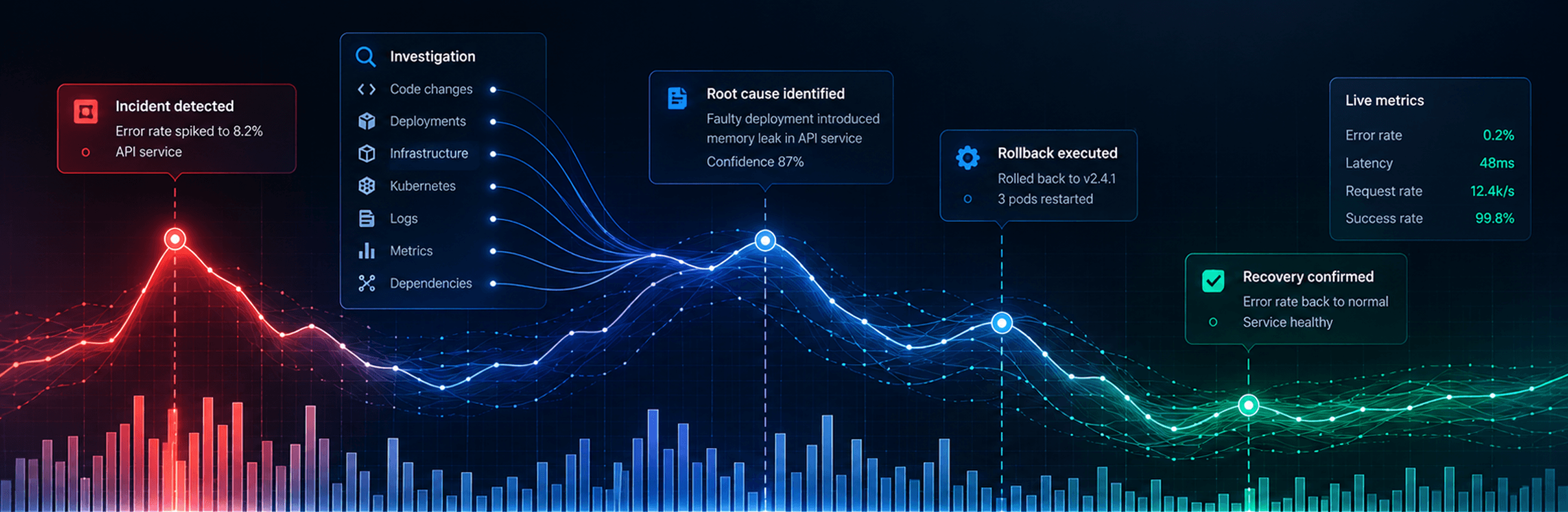
One incident across the pipeline: detection at an 8.2% error rate, parallel investigation, root cause identified at 87% confidence, rollback executed, and recovery confirmed with error rate back to 0.2%.

Full visibility into every decision and action

Autonomous incident response should never become a black box.

Pipeline maintains visibility into the investigation lifecycle, including agent activity, collected evidence, diagnostic findings, remediation proposals, policy decisions, approvals, execution results and verification outcomes.

Engineering teams can understand what Scrubbe investigated, why a particular action was recommended, whether it was authorized and what happened after execution.

This operational history supports incident reviews, troubleshooting, auditability and continuous improvement.

As historical incident knowledge grows, it can also inform future investigations and remediation decisions.

A coordinated response from signal to resolution

Modern engineering environments generate enormous volumes of operational data. The challenge is no longer simply collecting signals, but connecting them quickly enough to make informed decisions during production failures.

Scrubbe Pipeline brings investigation, reasoning, governance, execution and verification into a coordinated operational workflow. Specialized agents investigate in parallel. Evidence is correlated across systems. Remediation decisions are evaluated against operational controls. Approved actions are executed, and recovery is verified.

The result is a more structured, accountable and increasingly autonomous approach to production incident response.

Cookie preferences

We use essential cookies to keep Scrubbe secure and functional. You can choose whether to allow analytics, preferences, and marketing cookies, and update your choices at any time.

Essential cookies

Required for security, session continuity, consent state, and core site functionality. These are always on.

Always active

Analytics cookies

Help us understand usage patterns so we can improve product pages, onboarding paths, and documentation quality.

Allow analytics

Preference cookies

Remember selected settings such as region, UI preferences, and previously chosen site options.

Remember preferences

Marketing cookies

Enable campaign measurement and more relevant follow-up communications across trusted channels.

Allow marketing

Your choices are stored locally in this browser and can be updated at any time from the cookie settings button.