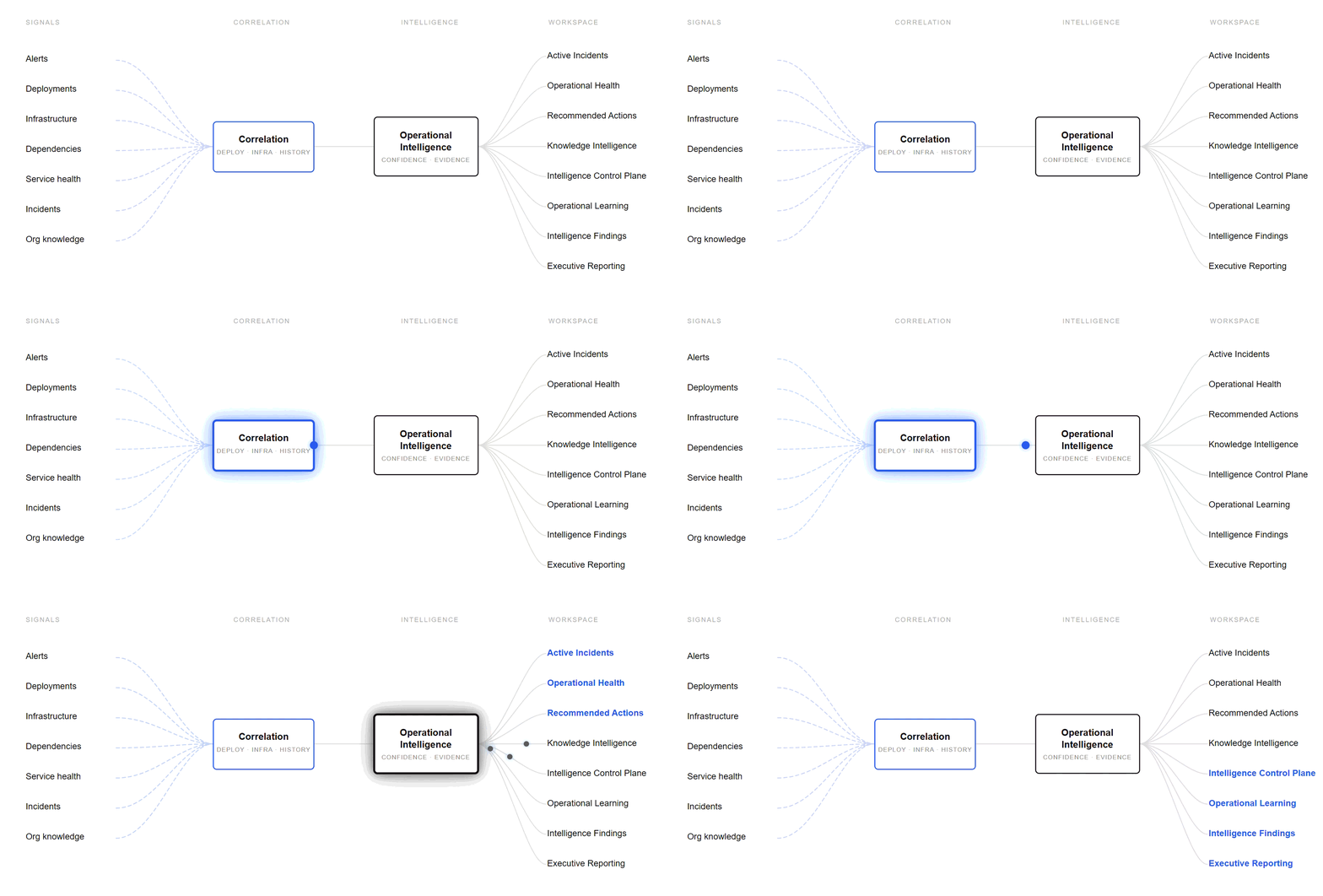
Systems detect failure.
They still can't fix it.
Intelligently.
A governed control loop for understanding incidents, choosing the right action, and moving toward resolution safely.
Scrubbe detects disruption early across distributed services and immediately coordinates response. Agents isolate the issue and propose a safe fix within minutes. Policies validate every step before execution. Systems recover before customer impact spreads.
From noisy production signals to
safe executable decisions.
Scrubbe is the control layer missing from modern production systems.
Not alerting ย ยทย Not monitoring ย ยทย Not coordination
Modern systems generate signals.
They do not generate answers.
Teams have alerts, dashboards, and logs. What they still lack is a system that understands what caused the issue, decides the right action, and executes safely.
From signals to safe action.
Scrubbe is the system that turns fragmented production signals into executable decisions โ with policy deciding whether action is allowed.
Logs ยท Metrics ยท Alerts
Signals
Collect production evidence from observability, code, pipelines, and human context.
Correlation ยท Causality
Root Cause
Connect symptoms to the most likely source instead of forcing engineers to hunt manually.
Fix Generation ยท Validation
Decision
Generate the safest viable action plan with confidence, reversibility, and blast-radius context.
Policy ยท Approval ยท Audit
Safe Execution
Execute only when governance clears the action, then preserve every decision as evidence.

Why Scrubbe exists
Systems can observe themselves โ but they cannot act on what they learn. Scrubbe closes that gap by turning fragmented data into clear decisions and executing them safely under policy.
For teams that can detect incidents โ but cannot safely resolve them.
Scrubbe is strongest where production failure creates pressure, ambiguity, and execution risk. Choose a user profile to see how Scrubbe fits their workflow.
Primary users operate the incident loop. Secondary users consume decisions, approve action, or measure risk reduction.
Platform & Infrastructure Teams
They own production reliability, deployment safety, and cross-service coordination. Scrubbe gives them a control layer that turns operational signals into governed action.
Current pain
Alerts and dashboards still leave teams manually reconstructing cause across services.
How Scrubbe fits
Correlates signals, identifies root cause, generates the safest action, and executes only under policy.

What they gain
Faster resolution with less escalation, lower execution risk, and a reusable incident control loop.
Best trigger
Frequent production incidents across many services, pipelines, and ownership boundaries.
A complete, auditable execution loop.
Scrubbe does not stop at notification or investigation. It carries the incident through understanding, decision, governance, and controlled action.
01
Root cause identified
Signals are correlated into a causal explanation with supporting evidence.
02
Fix generated
A safe remediation path is proposed with confidence and reversibility context.
03
Policy checked
Risk, blast radius, approvals, and execution limits are evaluated before action.
04
Execution completed
Approved remediation runs with full traceability and audit evidence.
A system that replaces manual incident response.
Scrubbe performs the full decision loop under policy: it understands the incident, selects the safest action, validates risk, and executes only when the gate clears.
Detect
Webhooks from GitHub, Kubernetes, Datadog, and PagerDuty arrive simultaneously. Scrubbe absorbs them all and collapses 40 duplicate alerts in 30 seconds into a single incident. Your engineers see one clear signal, not a flood.

Built for teams who
can't afford to guess.
Policy-Governed Execution
Engineering teams are stuck in reactive fire-fighting mode โ incidents are discovered late, triaged manually, and resolved through heroic individual effort rather than systematic process. There's no intelligent automation to accelerate detection-to-resolution.
9-State Incident Machine
Engineering teams are stuck in reactive fire-fighting mode โ incidents are discovered late, triaged manually, and resolved through heroic individual effort rather than systematic process. There's no intelligent automation to accelerate detection-to-resolution.
Policy โ Playbook
Engineering teams are stuck in reactive fire-fighting mode โ incidents are discovered late, triaged manually, and resolved through heroic individual effort rather than systematic process. There's no intelligent automation to accelerate detection-to-resolution.
Ezra Intelligence Layer
Engineering teams are stuck in reactive fire-fighting mode โ incidents are discovered late, triaged manually, and resolved through heroic individual effort rather than systematic process. There's no intelligent automation to accelerate detection-to-resolution.
Runtime Guardrails
Engineering teams are stuck in reactive fire-fighting mode โ incidents are discovered late, triaged manually, and resolved through heroic individual effort rather than systematic process. There's no intelligent automation to accelerate detection-to-resolution.
learnedPatterns Store
Engineering teams are stuck in reactive fire-fighting mode โ incidents are discovered late, triaged manually, and resolved through heroic individual effort rather than systematic process. There's no intelligent automation to accelerate detection-to-resolution.
See the pipeline
in motion.
Watch how Scrubbe takes an incident from raw signal to governed resolution โ end to end, no narration required.
Transcript here
[0:00] In this walkthrough we'll configure the maxAutomationLevel for your production environment. [0:42] Navigate to Settings โ Environments and select your production workspace. [1:15] The EAL (Effective Automation Level) is computed from three factors: risk classification, blast radius score, and the approval matrix you've defined. [2:30] Setting maxAutomationLevel to 2 means Scrubbe will propose fixes but require human approval before executing in production. [3:45] We'll walk through what happens when an incident triggers at level 3 โ the gate holds and routes to the approver on-call. [5:10] Finally, we'll verify the policy is enforced by replaying a recent incident through the simulation mode. [6:10] That's it โ your automation governance is now fully configured and auditable.
Native connectors.
One unified pipeline.
Every integration speaks the same language. Signals from 18 sources are normalised, deduplicated, and evaluated by the same governance layer โ so your team gets one incident, not eighteen alerts.

GitHub
Push events, PR merges, failed checks, deployment statuses

Kubernetes
CrashLoopBackOff, pod restarts, OOMKilled, failed deployments

Datadog
Metric alerts, SLO breaches, anomaly detection, monitors

PagerDuty
Alert triggered, incident acknowledged, resolved events

AWS
CloudWatch alarms, ECS task failures, Lambda errors

Prometheus
Alertmanager webhook receiver, rule evaluation events

Gitlab
Pipeline failures, merge requests, job status change

Grafana
Alerting webhooks, dashboard annotations, on-call alerts

Azure
Azure monitor alerts, AKS events, App Service

Google Cloud
Cloud Monitoring alerts, GKE events, Cloud Run errors

Slack
Incident notifications, approval requests, resolution summaries

Jira
Auto-create tickets on incident raise, sync state transitions
Built for industries
where downtime costs more
than the fix.
Every sector has a different definition of catastrophic. Scrubbe is architected to handle them all โ with the governance depth each one demands.
Financial Services
Milliseconds and compliance.
A payment rail failure measured in seconds produces regulatory reporting requirements measured in months. Scrubbe enforces PCI DSS, SOX, and MiFID II approval chains โ architecturally, not through configuration.
โ Payment gateway failures detected in <5s
โ Trading system latency โ confidence-scored fix before SLA breach
โ Core banking batch failures gated by Change Manager approval
Avg incident cost reduction
ยฃ2.4M/year, tier-1 bank
Healthcare & Life Sciences
When availability is clinical.
Downtime on a clinical decision support system is not a revenue event โ it is a patient safety event. Scrubbe's immutable audit trail, RBAC approval chains, and policy versioning satisfy HIPAA and FDA 21 CFR Part 11 by architecture.
โ EHR platform degradation โ blast radius includes medication admin
โ DICOM gateway failures gated by CISO approval
โ Full audit chain required for FDA submission support
Compliance coverage
HIPAA ยท FDA 21 CFRby architecture
E-Commerce & Retail
Revenue per second.
A 60-second checkout failure during Black Friday generates losses no post-mortem can fully account for. Scrubbe's pattern library turns recurring incident classes into solved problems โ the same fix that worked last time surfaces in seconds, not 20 minutes.
โ Traffic-triggered DB exhaustion โ pattern matched from first occurrence
โ Payment cascade failures โ blast radius to checkout mapped instantly
โ Flash sale failures resolved before revenue impact is measurable
Avg MTTR โ DB pool exhaustion class
4.2mvs 52m without pattern learning
SaaS & Cloud Platforms
Multi-tenant reliability at continuous scale.
40 deployments per day at 5% incident rate is two incidents a day requiring investigation, remediation, approval, and post-mortem. Scrubbe compresses this cycle. Detection to proposal in under 5 seconds. Approvals in Slack or Teams โ no context switching.
โ SLA breach exposure reduced 35โ60% for 99.9% uptime commitments
โ Multi-tenant blast radius โ enterprise vs free-tier impact distinguished
โ Auth service JWT failures โ CASCADE blast radius across all tenants
SLA breach exposure reduction
35โ60%for 99.9% commitments
Government & Public Sector
Audit first. Always.
Every change to a citizen-facing system must be documented, attributable, and subject to external audit โ not as an afterthought, but as a first-class property. Scrubbe resolves the public sector paradox: the change management process itself is automated, not the changes.
โ GDS standards and NCSC Cyber Essentials documented via audit trail
โ NHS DSP Toolkit compliance baked into guardrail evaluation
โ Retroactive audit queries โ no log correlation required
Audit trail completeness
100%every action attributable
Manufacturing & Industrial IoT
OT/IT convergence demands governance.
A software failure in a manufacturing execution system is not an availability event โ it is a production stoppage with supply chain and safety implications. Scrubbe permanently enforces Stage 2 approval for any action adjacent to physical systems. No exceptions, regardless of automation settings.
โ MES failures โ blast radius maps to assembly line, not just software
โ SCADA integration failures trigger enhanced approval chains
โ Physical-adjacent systems permanently gated โ never automated
Physical system governance
Stage 2 min.human approval always
Ready to see it in your stack?
Download the full enterprise ebook โ all six domain chapters.
Every action.
Immutably recorded.
Scrubbe's audit trail is append-only by design โ not by configuration. There is no delete endpoint, no update endpoint. The data store rejects modification at the database level. Every state transition, policy evaluation, approval, guardrail check, and execution is immutably recorded with actor, role, timestamp, and the exact policy version that governed it.
The core promise
When something breaks in your engineering systems, Scrubbe finds it, understands it, decides what to do about it, gets the right approvals, fixes it and learns from it. All under a controlled, auditable framework your compliance and leadership teams can trust.
- Scrubbe Founders
One War Room. Total Clarity.
Controlled Execution from Start
to Resolution
Slack War Room
โงTurn Slack into a structured incident command center
Scrubbe transforms Slack channels into live war rooms where engineers and agents collaborate in real time. Context flows directly into the conversation, decisions are visible, and actions are triggered safelyโwithout leaving Slack.
Microsoft Teams War Room
โจMake Teams the single source of truth during incidents
Scrubbe turns Teams into a governed war room where communication, context, and execution come together. Every message, decision, and action is structured, tracked, and controlledโright inside Teams.
Zoom War Room
โจBring structure and execution into live incident calls
Scrubbe augments Zoom war rooms with real-time context, agent insights, and controlled actions. While teams collaborate live, Scrubbe ensures decisions are captured and execution happens safely alongside the call.
Scrubbe API Section
Programmable
Incident Control.
Build incident automation directly into your stack with Scrubbe's governed API.
Integrate incident intelligence, approvals, investigations, and remediation into your internal tools, CI/CD pipelines, chatops workflows, and monitoring systems.
Scrubbe API gives engineering teams a programmable control plane for incident response โ so incidents can be triggered, analyzed, approved, and resolved through code.
{
"incident_id": "inc_8f4a7c2b",
"status": "created",
"severity": "high",
"service": "checkout-api",
"created_at": "2023-05-20T10:24:31Z",
"investigation": {
"investigation_id": "inv_d3e9b1a2",
"status": "started"
},
"links": {
"self": "https://api.scrubbe.com/v1/incidents/inc_8f4a7c2b"
}
}Why teams use Scrubbe API
Trigger incidents from anywhere
Raise incidents directly from your own systems. Send incidents directly from your own systems โข Monitoring tools โข Internal services โข CI/CD pipelines โข Custom webhooks โข Security alerts Instead of manually opening incidents, teams can automatically trigger workflows when critical thresholds are reacted
Automate investigations
Programmatically start investigations the moment an incident is raised. The API can: โข create investigation sessions โข fetch correlated signals โข match playbooks โข retrieve root cause hypotheses โข generate remediation options This means your systems can automatically move from detection to analysis without waiting for human coordination.
Enforce approvals before execution
Scrubbe API is policy-aware. Every execution request is evaluated against: โข approval rules โข risk thresholds โข service criticality โข blast radius analysis โข role permissions High-risk actions can be blocked or routed for approval automatically. This lets teams automate safely without giving uncontrolled execution access.
Execute remediation through code
Trigger approved remediation actions directly through API. Examples: โข rollback deployment โข restart service โข scale replicas โข invalidate cache โข rotate credentials โข pause rollout Execution only proceeds when policies allow it. This gives teams automation speed without sacrificing operational governance.
Build internal tooling on top of Scrubbe
Engineering teams can embed Scrubbe directly into internal platforms. Common use cases: โข internal incident portals โข deployment gates โข release health checks โข runbook automation โข engineering command centers โข custom dashboards Scrubbe becomes infrastructure, not just another UI.
Scrubbe API enables controlled, programmatic incident remediation
Allow external systems to trigger governed multi-agent workflows that diagnose issues, evaluate safe fixes, and execute approved actions. โข Controlled, programmatic incident remediation โข External systems trigger governed multi-agent workflows โข Diagnose issues, evaluate safe fixes, execute approved actions โข Strict policies and audit controls Automatically detect and fix problems using AI agents โ but with guardrails, approvals, and logging so nothing goes rogue or unchecked.
API Capabilities
Incident APIs
Investigation APIs
Approval APIs
Execution APIs
โก Ezra Code Engine
Intelligence that reads your
code, not just your alerts.
When Ezra identifies a code-level root cause, it surfaces a targeted diff against the affected file โ with confidence score, playbook provenance, and a one-click PR to the source repo. Every suggestion is traceable to the incident that triggered it.
0.91
Avg. confidence score
<40s
Suggestion to PR open
100%
Auditable โ every suggestion logged
CI ยท 3 CHECKS FAILED
auth.algorithm.test โ FAIL โ no algorithm constraint
auth.issuer.test โ FAIL โ issuer not validated
deploy.version.test โ FAIL โ header missing
Root Cause Analysis
JWT alg:none attack surface
verifyJwt() called without an explicit algorithm constraint. An attacker can forge tokens using alg:none โ bypassing signature verification entirely.
Issues detected
โ No algorithm constraint
โ Issuer not validated
โ Deploy version header missing
Incident
CI Status
3 checks failed
auth.algorithm.test โ FAIL
auth.issuer.test โ FAIL
deploy.version.test โ FAIL
Root cause logged to audit trail
Versioned from day one
All endpoints under /api/v1/. Breaking changes always get a new version โ never in place.
Every call audited
JWT identity tied to the audit trail. Not a config flag โ enforced by architecture on every request.
Idempotent ingestion
Duplicate events from webhook retries are deduped automatically. No double incidents, no extra work.
5 SDK languages
TypeScript, Python, Go, Ruby, and cURL. All published to native registries with full type coverage.
Migrating from another platform?
Switch to governed incident intelligence.
We'll handle the migration.
Teams switching from PagerDuty, OpsGenie, FireHydrant, Incident.io, Statuspage, and custom in-house tools have a dedicated migration path. Your existing playbooks, escalation policies, and alert routing move across โ with full audit continuity from day one.
Cookie & Privacy Settings
Scrubbe uses cookies and similar technologies to enhance your experience, analyze traffic, and enable personalized content. Choose your preferences below.
Essential Cookies
These cookies are necessary for the website to function properly. They cannot be disabled.
Analytics Cookies
These cookies help us understand how visitors interact with the website, helping us improve our services.
Functional Cookies
These cookies enable personalized features and notifications to enhance your experience.
Marketing Cookies
These cookies are used to track visitors across websites to display relevant advertisements.