

Scrubbe Logo

Autonomous response, with control at every critical decision

AI agents can investigate a production incident, reason across complex systems and identify a path to recovery. But when production is at risk, capability alone is not enough.

Contact Us

Scrubbe Governance provides the controls that answer those questions.

Operational policies, risk controls, approval requirements, execution boundaries and audit trails are built into the incident response process. Agents can investigate and reason.

Policies determine what they are permitted to do. And when an incident reaches a critical decision point, Scrubbe applies the appropriate control before allowing the response to continue.

Autonomy should increase the speed of response without removing operational authority.

Define the boundaries.

Every engineering organization operates differently. A change that may be acceptable in development could require explicit approval in production. A rollback of one service may be routine, while changing a critical database during a P0 incident may require several safeguards. Scrubbe allows teams to define Operational Rules that establish these boundaries.

Rules can determine:

  • Which actions are permitted
  • Which actions require approval
  • Which actions are restricted to specific environments
  • Which services require stronger controls
  • What level of confidence is required
  • What level of risk is acceptable
  • What actions must never be automated
  • What verification is required after execution

Governance where it matters.

Governance should not appear only at the moment an engineer clicks “approve.”

In a production incident, important decisions happen throughout the response.

Scrubbe applies governance at critical stages of the incident lifecycle:

This creates a controlled path from investigation to action rather than giving an autonomous system unrestricted authority.

01

Investigation

What systems and information can agents access?

02

Diagnosis

What evidence and confidence are sufficient to support a remediation decision?

03

Remediation

What actions are permitted for this incident, service and environment?

04

Approval

What is Scrubbe actually allowed to change?

05

Verification

What must be confirmed before the incident can be considered resolved?

The right control at the right moment.

Not every incident requires the same level of intervention.

  • A routine, reversible action affecting a low-risk service may be allowed to proceed automatically.
  • A change affecting a critical production service may require explicit approval.
  • A high-risk or prohibited action may be blocked entirely.

The objective is not to put an approval button in front of every action.

The objective is to put the right control in front of the right action.

Scrubbe evaluates the context before an action proceeds, considering factors such as:

  • Incident priority
  • Environment
  • Service criticality
  • Risk
  • Confidence
  • Blast radius
  • Reversibility
  • Policy

This allows teams to define where autonomy is appropriate and where human authority must remain in the loop.

Critical incidents require stronger controls.

Production incidents are not all equal.

A P3 affecting a non-critical service should not necessarily be governed in the same way as a P0 affecting a critical customer-facing system.

Scrubbe can apply stronger controls as the potential impact increases.

For a critical incident, governance can require:

  • Higher diagnostic confidence
  • Additional evidence
  • Explicit human approval
  • Restricted remediation options
  • Limited execution scope
  • Additional verification
  • Escalation when conditions change
  • Blocking of actions outside defined boundaries

This means autonomy can scale with confidence and operational risk.

The more consequential the action, the stronger the control.

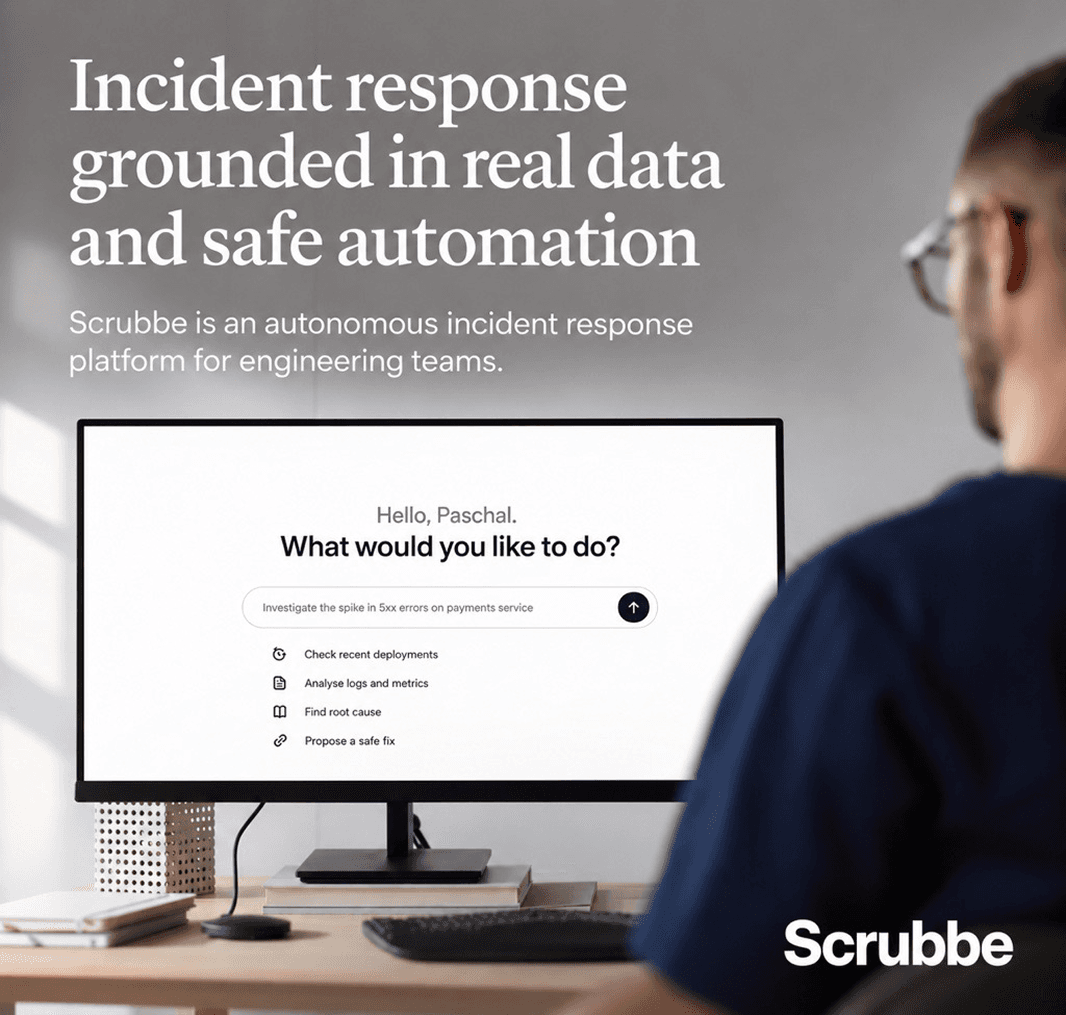
An engineer at a workstation running an incident investigation in Scrubbe.
Colleagues walking together through a sunlit atrium.

Investigation does not mean execution.

An agent may need broad visibility to understand an incident.

That does not mean it should have broad authority to change the environment.

Scrubbe separates investigation authority from execution authority.

An agent may be permitted to inspect:

  • Logs
  • Metrics
  • Deployments
  • Code changes
  • Infrastructure
  • Service dependencies
  • CI/CD activity

while having no authority to modify those systems.

If the investigation produces a remediation proposal, that proposal enters a separate governed path.

This distinction is fundamental to safe autonomous operations.

The ability to understand a system should never automatically grant the ability to change it.

Execution remains a governed action.

When remediation is approved, Scrubbe does not simply hand control to an agent.

Execution remains bounded by the permissions and policies associated with the action.

Scrubbe records:

  • What action was authorized
  • What system was affected
  • What scope was permitted
  • Who or what authorized it
  • What was executed
  • When it happened
  • What happened afterward

If conditions change during execution or the action moves outside its permitted boundaries, Scrubbe should be able to stop, escalate or require further authorization rather than continuing blindly.

Approval is not unrestricted access.

It is authorization for a defined action under defined conditions.

Governance should enable autonomy, not prevent it.

Governance is not intended to slow every incident down

Governance is not intended to slow every incident down.

Its purpose is to make greater autonomy possible.

As teams gain confidence in specific remediation patterns, they can define policies that allow those actions to proceed with less intervention.

Other actions can remain subject to stronger controls.

Over time, organizations can move from:

ManualAssistedApproved automationControlled autonomy

without having to choose between operational speed and production safety.

The organization remains in control of the boundaries. Scrubbe operates within them.

Verification is part of governance.

Execution is not the end of the decision.

Scrubbe verifies whether the remediation produced the expected result.

Depending on the incident, this may include checking:

  • Error rates
  • Latency
  • Service health
  • Alerts
  • Deployment state
  • Infrastructure signals
  • Dependency health
  • Customer-facing impact

If the expected recovery does not occur, the incident should not simply be marked resolved.

Scrubbe can return the incident to investigation, escalate it or evaluate another remediation path according to the applicable policies.

A successful execution is not the same as a successful remediation.

The outcome must be verified.

Cookie preferences

We use essential cookies to keep Scrubbe secure and functional. You can choose whether to allow analytics, preferences, and marketing cookies, and update your choices at any time.

Essential cookies

Required for security, session continuity, consent state, and core site functionality. These are always on.

Always active

Analytics cookies

Help us understand usage patterns so we can improve product pages, onboarding paths, and documentation quality.

Allow analytics

Preference cookies

Remember selected settings such as region, UI preferences, and previously chosen site options.

Remember preferences

Marketing cookies

Enable campaign measurement and more relevant follow-up communications across trusted channels.

Allow marketing

Your choices are stored locally in this browser and can be updated at any time from the cookie settings button.