
Map Impact Before Acting
A production incident rarely exists in isolation. A failure in one service can affect several others, disrupt critical workflows, and create consequences that extend far beyond the component where the problem first appeared.
For engineering organizations operating distributed systems, the ability to assess potential impact is essential to safe incident response.

A local failure can become a system-wide problem
A local failure can become a system-wide problem
Modern applications depend on interconnected services, shared infrastructure, databases, messaging systems, and external providers.
These dependencies allow organizations to build and scale complex products, but they also create paths through which failures can propagate.
An authentication service experiencing elevated latency may affect every application that depends on it. A database connection issue may cause requests to fail across several services. A networking change may disrupt communication between components that otherwise appear healthy.
The initial failure may be limited to one system, but its consequences can spread through the architecture.
This creates a difficult investigative problem.
Engineers may observe errors in multiple services without immediately knowing whether they represent separate incidents or downstream effects of the same underlying failure.
The component generating the most alerts may not be the component responsible for the problem.
A payment service may report failed transactions because an upstream dependency is unavailable. An API gateway may experience increased latency because a downstream application is struggling. A queue may accumulate messages because the service responsible for processing them has stopped responding.
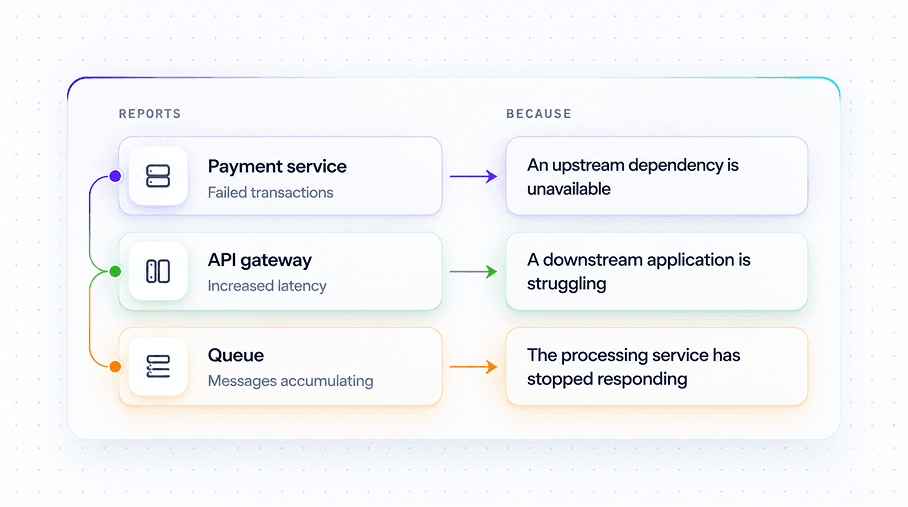
Understanding the incident requires examining these relationships.
Without a clear view of dependencies and failure propagation, engineering teams risk investigating symptoms independently or applying remediation to the wrong component.
The danger of acting on incomplete context
The danger of acting on incomplete context
During an active incident, engineers often face pressure to restore service before every detail of the failure is understood.
That pressure is understandable.
When customers cannot access an application or a critical service is unavailable, delaying remediation may prolong disruption.
However, acting without sufficient context can create additional problems.
Consider a service experiencing increased memory consumption and repeated failures. Restarting the service may appear to be a reasonable recovery action.
But if the service maintains critical state, processes long-running workloads, or depends on another unhealthy component, the restart may interrupt additional operations without addressing the underlying cause.
A deployment rollback introduces similar considerations.
The previous application version may not be compatible with a database migration introduced by the new release. Other services may already depend on updated interfaces or configuration values.
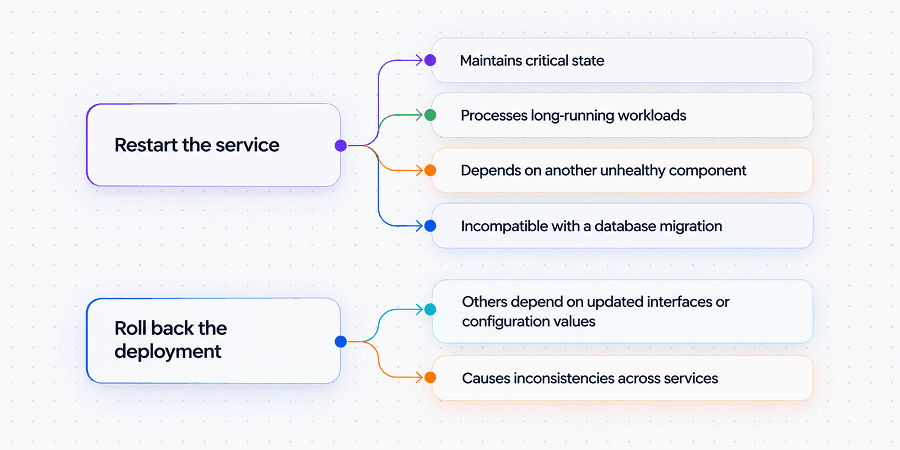
Rolling back the affected application without examining these relationships can create new failures.
The problem is not that these remediation actions are inherently unsafe.
It is that their consequences depend on the environment in which they are performed.
A technically valid action may still be operationally inappropriate.
Effective incident response must therefore consider not only whether a proposed action could resolve the immediate failure, but also what else it could affect.
Blast radius is more than the number of affected services
Blast radius is more than the number of affected services
Blast radius is often discussed in terms of how many systems may be affected by a failure or change.
That is an important consideration, but it does not capture the full operational risk.
The significance of an affected component depends on its role within the architecture, the workloads it supports, and the consequences of disruption.
A failure involving a small internal service may have limited customer impact. A problem affecting a shared authentication system, transaction processor, or central database may influence a much larger portion of the product.
Similarly, a change affecting a single resource can have substantial consequences if that resource supports critical dependencies.
Understanding blast radius therefore requires more than counting services.
Engineering teams need to consider dependency relationships, shared infrastructure, traffic flows, operational criticality, and the potential consequences of intervention.
They must also distinguish between systems already affected by the incident and systems that could become affected by a proposed remediation.
These are related but different questions.
The first concerns the current scope of the failure.
The second concerns the additional risk introduced by taking action.
Illustrative dependency map. Choose where the failure starts, then where you would act, and compare the two. Arrows point from a dependency to what relies on it.
A reliable remediation decision should account for both.
Why dependency context matters
Why dependency context matters
In distributed environments, services rarely operate independently.
Applications communicate through APIs, message queues, databases, and shared infrastructure components. Their behaviour is influenced by upstream providers and downstream consumers.
These relationships determine how failures propagate.
They also determine how remediation actions can affect other systems.
For example, restarting a shared service may temporarily interrupt every application that depends on it.
Changing traffic routing may shift load toward infrastructure that lacks sufficient capacity.
Increasing resources for one workload may affect resource availability elsewhere in a constrained environment.
A configuration change intended to restore one service may alter the behaviour of other components that rely on the same settings.
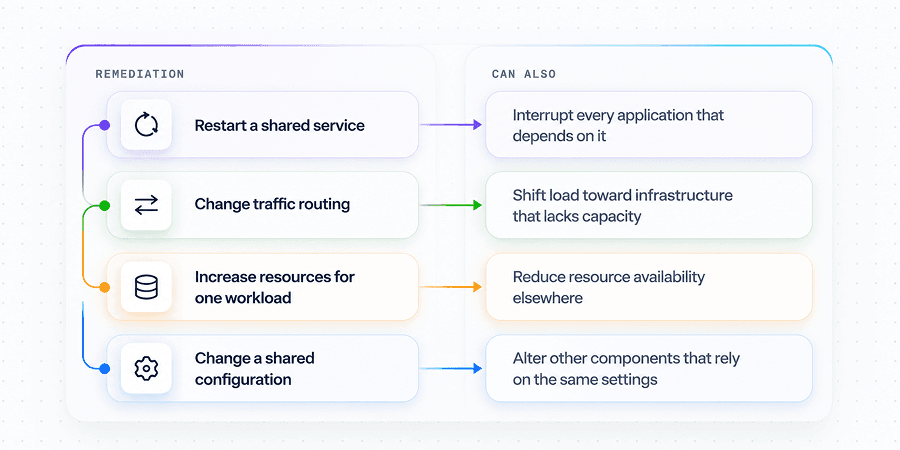
Engineers need to understand these relationships before selecting an action.
Yet dependency information is often distributed across architecture diagrams, service catalogues, observability platforms, infrastructure configurations, and individual engineers' knowledge.
Some records may be incomplete or outdated.
During an incident, reconstructing the relevant dependency context can take valuable time.
The challenge becomes more significant as infrastructure evolves and services are deployed independently.
A remediation process that relies entirely on manually consulting static architecture documentation may struggle to reflect the current production environment.
Operational decisions need to be informed by the most relevant and current evidence available.
From isolated signals to connected impact
From isolated signals to connected impact
Scrubbe is designed to help engineering teams investigate production failures within the context of the systems they affect.
Its Signal Graph connects operational signals, service relationships, and relevant events to support a broader understanding of incident behaviour.
Rather than treating each alert as an isolated condition, Scrubbe's investigation agents can examine how affected components relate to one another and whether the observed symptoms share a likely underlying cause.
The Ezra intelligence layer coordinates reasoning across these investigations.
When an incident involves several services, agents can examine dependency relationships, infrastructure behaviour, deployment activity, and other operational evidence.
This can help establish whether a failure originated in a shared component or whether multiple independent conditions are contributing to the incident.
The same context is relevant when considering remediation.
Before an action is taken, engineers need to understand which resources may be affected and whether the proposed change could introduce additional disruption.
Scrubbe's connected investigation model is intended to provide evidence that supports these assessments.
It should not be treated as a guarantee that every downstream consequence can be predicted.
Production systems contain dynamic dependencies, incomplete telemetry, and interactions that may not be fully visible.
Where the available evidence does not establish the likely impact of an action, that uncertainty should remain part of the decision.
The purpose is to improve operational understanding before execution, not to replace uncertainty with unsupported confidence.
Map the consequences before choosing the action
Map the consequences before choosing the action
A remediation decision should begin with a clear understanding of what the action is intended to accomplish.
If an application is failing because of a recent deployment, a rollback may be appropriate.
If a service is unhealthy because of resource exhaustion, changing capacity or restoring the underlying dependency may be necessary.
If a configuration error has disrupted communication between services, correcting that configuration may provide a direct path to recovery.
But identifying a potential solution is only the beginning.
The proposed action must be evaluated against the environment in which it will occur.
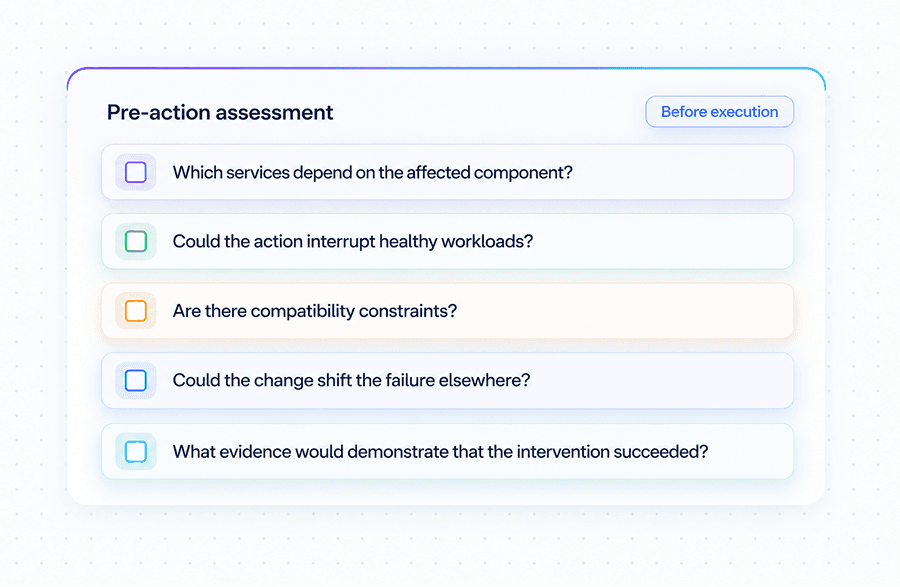
These questions help distinguish a plausible remediation from an operationally justified one.
In some cases, a limited action may reduce risk by containing the failure before a broader change is considered.
In others, restoring a shared dependency may be more appropriate than applying separate workarounds across affected services.
The right decision depends on the incident, the architecture, and the evidence available.
Scrubbe's autonomous investigation capabilities are designed to help establish that context so remediation decisions can be made with a clearer understanding of potential impact.
Reliability depends on controlling consequences
Reliability depends on controlling consequences
Production reliability is not measured solely by how quickly an individual service can be restored.
It also depends on whether the response protects the wider environment from avoidable disruption.
An aggressive remediation may shorten the immediate investigation but increase the total impact of the incident.
A carefully scoped action may require additional assessment but reduce the risk of affecting healthy services.
The appropriate balance depends on the severity of the failure, the urgency of recovery, and the potential consequences of intervention.
Engineering teams need sufficient context to make that judgment.
As systems become more distributed, this requires a clearer understanding of dependencies, operational relationships, and the effects of production changes.
Scrubbe is designed to support that understanding through connected investigations, evidence-based reasoning, and policy-governed execution.
Its agents can examine potential causes and relevant system relationships, while organizational policies determine which remediation actions are permitted.
Verification then provides evidence about the outcome.
This creates a more accountable approach to incident response in which the goal is not simply to perform a corrective action, but to restore service without introducing unnecessary additional risk.
Understand the impact before changing production
Understand the impact before changing production
Blast radius risk becomes difficult to manage when engineering teams must act without a clear understanding of the systems connected to the failure.
An incident may begin in one component, but its consequences can extend across dependencies, workloads, and customer-facing services.
Remediation can create similar effects.
Scrubbe brings autonomous investigation, connected operational context, policy-governed execution, and recovery verification into the response process.
Its agents are designed to examine relationships between affected systems, support evidence-based remediation decisions, and operate within the boundaries established by the organization.
High-risk actions remain subject to the appropriate controls and approvals.
The objective is to help engineering teams act with greater confidence while limiting the possibility that an intervention makes the incident worse.
Because restoring one service should not come at the expense of destabilizing the rest of the environment.

Understand the impact.
Control the action.
Investigate dependencies, assess potential consequences, and keep autonomous remediation within approved operational boundaries with Scrubbe.
Cookie preferences
We use essential cookies to keep Scrubbe secure and functional. You can choose whether to allow analytics, preferences, and marketing cookies, and update your choices at any time.
Essential cookies
Required for security, session continuity, consent state, and core site functionality. These are always on.
Analytics cookies
Help us understand usage patterns so we can improve product pages, onboarding paths, and documentation quality.
Preference cookies
Remember selected settings such as region, UI preferences, and previously chosen site options.
Marketing cookies
Enable campaign measurement and more relevant follow-up communications across trusted channels.
Your choices are stored locally in this browser and can be updated at any time from the cookie settings button.