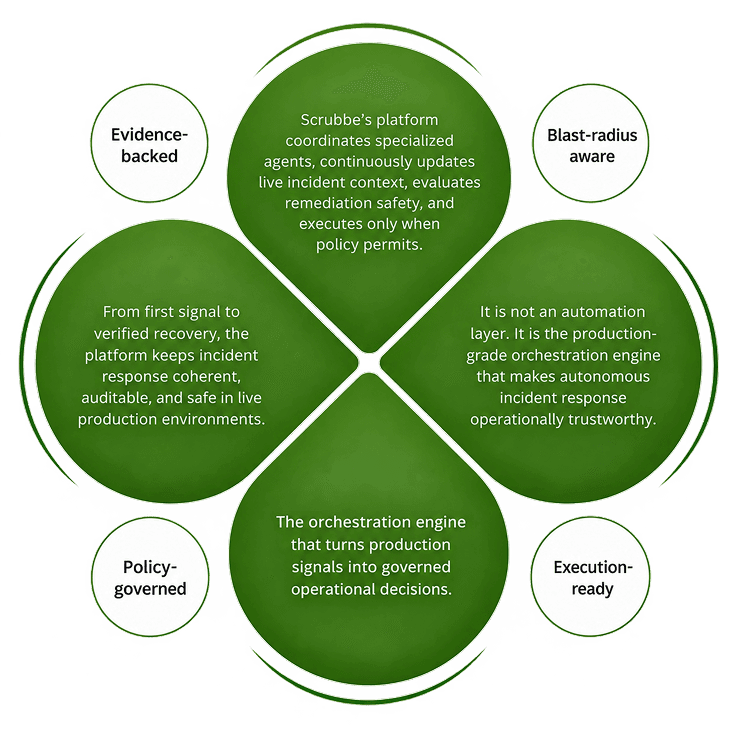
The orchestration engine at the center of every incident.
Scrubbe's platform is the core orchestration engine that coordinates incident investigation, decision-making, and governed execution across the production stack. It is not a collection of disconnected agents.
It is the control layer that turns production signals, system context, policy constraints, and execution pathways into one governed operational workflow — from first detection through verified recovery.
Platform invariant No remediation is executable unless it is evidence-backed, blast-radius-scored, and policy-approved.
Foundation
A governed orchestration layer for production systems
Orchestration
During an incident, Scrubbe continuously ingests changes across code, CI/CD pipelines, infrastructure, observability systems, service topology, and deployment state. It normalizes those signals into a single operational context, dispatches specialized agents in parallel, correlates evidence across domains, and drives the incident decision loop from first detection through verified recovery.
The platform is built for live production environments where correctness, auditability, and controlled execution matter as much as speed. Scrubbe does not optimize for the fastest possible action. It optimizes for the correct action, taken safely, with full traceability.
The platform does not treat agent output as final truth. It continuously reconciles agent findings against live production evidence, historical context, service topology, policy constraints, and execution risk before advancing the decision process.

Context
Unified operational context
Signal Normalization
Production incidents rarely fail inside one isolated system. Root causes usually span multiple layers of the stack — a deployment in one service, a configuration drift in another, a dependency degradation that has been slowly propagating for minutes before the first alert fires. Treating these as separate problems produces fragmented investigations. Scrubbe treats them as one.
Scrubbe maintains a continuously updated operational context that combines every relevant signal from across the production environment into a single shared state. Every agent dispatched during an incident operates against this context rather than accessing systems independently. As new evidence arrives — a fresh metric anomaly, a newly resolved alert, a parallel deployment completing elsewhere in the stack — the platform immediately incorporates that signal and recalculates downstream reasoning.
This means hypothesis rankings, blast radius assessments, and remediation confidence scores are never static. They reflect what the production environment actually looks like at the moment of each decision, not what it looked like when the incident first opened.
Unified operational context — signal sources
Architecture
Parallel investigation, single decision path
Orchestration Model
Speed matters during incidents, but parallelism without coordination creates noise. When multiple agents investigate independently and return conflicting signals without a central authority to reconcile them, the result is not faster resolution — it is a wider disagreement about what is actually wrong. Scrubbe separates parallel investigation from centralized orchestration to avoid this failure mode entirely.
Multiple agents investigate independently and simultaneously across their respective domains. The orchestration engine runs separately and continuously above them, collecting their outputs, reconciling conflicts, and advancing the decision process through a single coherent path. No agent output is accepted as truth and forwarded to execution without passing through this central reconciliation layer.
This architecture allows Scrubbe to scale investigation depth without proportionally increasing the complexity of the decision process. Adding another agent does not fragment the decision path. The orchestration engine absorbs the new input and continues to produce one operationally coherent output.
Correlate evidence across domains
Agent outputs from code, deployment, runtime, and dependency domains are correlated against each other and against the live operational context rather than evaluated in isolation.
Resolve conflicting signals
When agents return contradictory findings — a deployment agent pointing to a configuration change while a runtime agent points to a resource saturation — the orchestration engine weighs each against the full evidence set and resolves the conflict explicitly rather than deferring it.
Rank competing root-cause hypotheses
All plausible explanations for the observed failure are ranked by confidence score — a function of timing, service locality, failure pattern alignment, dependency propagation, and similarity to prior incidents — and maintained as a ranked set that persists through the full decision loop.
Map remediation candidates to operational risk
Each proposed remediation is assessed for its projected blast radius, recovery probability, execution risk, and reversibility before it is considered for policy evaluation. Candidates that carry unacceptable risk profiles are surfaced but not advanced.
Determine which path advances to policy evaluation
Only the remediation candidate that best satisfies the current evidence, risk, and operational constraints is advanced to the policy gate. All other candidates remain ranked and available for immediate activation if the chosen path fails or is blocked.
Governance
Policy-governed execution
Execution Policy
The platform does not execute actions simply because a likely fix exists. A high-confidence hypothesis and a well-evidenced remediation candidate are necessary conditions for execution, but they are not sufficient ones. Every proposed remediation passes through policy evaluation before execution is permitted, regardless of how strong the evidence is or how low the assessed risk appears.
Execution policy in Scrubbe is not a single boolean gate. It is a structured evaluation against a configurable set of governance rules that reflect the operational constraints of the organization running the platform. A remediation that is appropriate for a staging environment may be prohibited in production. An action with a low blast radius may still require human approval for services above a certain criticality tier. Policy captures all of these distinctions explicitly, and every evaluation is recorded in full.
Only when all applicable policy conditions are satisfied does Scrubbe allow execution to proceed. That is how the platform supports autonomous incident response without giving up the operational control that production environments require.
Execution policy — evaluated conditions
Environment sensitivity
Production, staging, and pre-production environments carry different policy thresholds. Actions permissible in lower environments may require explicit approval or be blocked outright in production.
Incident severity
Higher-severity incidents may unlock additional autonomous action authority, or may conversely require more stringent approval chains depending on organizational policy configuration.
Service criticality
Services above a configured criticality tier require human approval for any remediation action, regardless of confidence score, blast radius assessment, or incident severity classification.
Blast radius threshold
Actions whose projected operational impact exceeds the configured blast radius limit are escalated for approval or blocked, even when the action's evidence chain is strong and reversibility is high.
Remediation confidence
A minimum confidence threshold must be met before any autonomous execution is permitted. Candidates below the threshold are surfaced as options for human-initiated action rather than autonomous execution.
Reversibility
Actions with low reversibility scores — those that are difficult or impossible to undo cleanly — carry additional policy weight and typically require explicit approval regardless of other conditions.
Change freeze windows
Active change freeze periods prohibit autonomous execution entirely. During a freeze, Scrubbe continues to investigate, rank hypotheses, and prepare remediation options — but all execution requires explicit human authorization.
Approval requirements
Specific action types, service tiers, or environment combinations may require approval from a named team lead, on-call engineer, or defined approval chain before execution is permitted.
Environment sensitivity
Production, staging, and pre-production environments carry different policy thresholds. Actions permissible in lower environments may require explicit approval or be blocked outright in production.
Incident severity
Higher-severity incidents may unlock additional autonomous action authority, or may conversely require more stringent approval chains depending on organizational policy configuration.
Service criticality
Services above a configured criticality tier require human approval for any remediation action, regardless of confidence score, blast radius assessment, or incident severity classification.
Blast radius threshold
Actions whose projected operational impact exceeds the configured blast radius limit are escalated for approval or blocked, even when the action's evidence chain is strong and reversibility is high.
Remediation confidence
A minimum confidence threshold must be met before any autonomous execution is permitted. Candidates below the threshold are surfaced as options for human-initiated action rather than autonomous execution.
Reversibility
Actions with low reversibility scores — those that are difficult or impossible to undo cleanly — carry additional policy weight and typically require explicit approval regardless of other conditions.
Change freeze windows
Active change freeze periods prohibit autonomous execution entirely. During a freeze, Scrubbe continues to investigate, rank hypotheses, and prepare remediation options — but all execution requires explicit human authorization.
Approval requirements
Specific action types, service tiers, or environment combinations may require approval from a named team lead, on-call engineer, or defined approval chain before execution is permitted.
Execution
Controlled execution and verification
Execution Layer
When remediation is approved, the platform executes through controlled adapters connected to production systems. Execution is not a fire-and-forget operation. It is a guarded sequence of steps designed to ensure that every change applied to the production environment is observable in real time, reversible if needed, and permanently attributable to its incident and approver.
After execution completes, Scrubbe does not assume success. The platform immediately verifies recovery against live production signals, checking whether error rates have normalized, whether latency has returned to baseline, whether resource utilization is stabilizing, and whether any secondary degradation has been introduced as a consequence of the remediation action. Service stabilization is confirmed before the incident is closed. If verification fails — if the action did not produce the expected recovery — the platform re-enters the decision cycle with the updated evidence rather than terminating prematurely.
Pre-execution state capture
A full snapshot of the current system state is captured and committed to the incident record before any change is applied. This snapshot is the baseline against which rollback is executed if the action does not produce recovery.
Idempotency safeguards
Each execution is keyed against a combination of the incident identifier and action identifier. Duplicate execution attempts triggered by network interruptions or system failures are intercepted and suppressed before they reach production systems.
Rollback pathways
Every action has an associated rollback pathway defined before execution begins. If verification confirms that the action did not produce recovery, rollback can be initiated immediately without requiring a new remediation planning cycle.
Timeout protections
Execution steps are time-bounded. If an action does not complete within the expected window, Scrubbe surfaces the timeout, initiates rollback evaluation, and prevents the system from being left in a partially applied state.
Execution audit trails
Every step of execution — start time, parameters applied, system responses, completion time, and final state — is committed to the audit trail in real time. The execution record is permanent, structured, and replayable for retrospective review or compliance audit.
Cookie preferences
We use essential cookies to keep Scrubbe secure and functional. You can choose whether to allow analytics, preferences, and marketing cookies, and update your choices at any time.
Essential cookies
Required for security, session continuity, consent state, and core site functionality. These are always on.
Analytics cookies
Help us understand usage patterns so we can improve product pages, onboarding paths, and documentation quality.
Preference cookies
Remember selected settings such as region, UI preferences, and previously chosen site options.
Marketing cookies
Enable campaign measurement and more relevant follow-up communications across trusted channels.
Your choices are stored locally in this browser and can be updated at any time from the cookie settings button.