
Collapse Noise Into Signal
Production systems generate a constant stream of operational information. Monitoring platforms track infrastructure health, application performance, service availability, network behaviour, and thousands of individual conditions that may indicate something is wrong.
Book a demo
When every signal demands attention
Monitoring systems are designed to identify abnormal conditions
That function is essential. Without reliable monitoring, engineering teams may not recognize production failures until customers begin reporting them. However, an alert does not automatically represent a distinct operational problem.
Some alerts indicate genuine service degradation. Others reflect transient conditions that resolve without intervention. Some are consequences of an existing failure, while others provide useful supporting evidence about what caused it.
When these distinctions are not established, engineers are left to evaluate large numbers of notifications individually. An on-call engineer may receive an alert for elevated latency, followed by another for application errors, another for database connections, and several more from downstream services.
The notifications may arrive within seconds of one another, each carrying its own severity, threshold, and monitoring context. Although the alerts may be technically accurate, they do not necessarily explain their relationship to one another. The engineer must reconstruct that relationship manually.
Understanding the incident behind the alerts
Modern incidents rarely originate from a single source.
A meaningful operational signal is not defined solely by the threshold that generated it. Its importance depends on what it reveals about the condition of the system.
An increase in latency may be significant because it affects customer requests. A rise in memory consumption may be relevant because it precedes service instability. A deployment event may matter because it provides evidence of a change associated with the onset of errors. These observations become more useful when examined together.
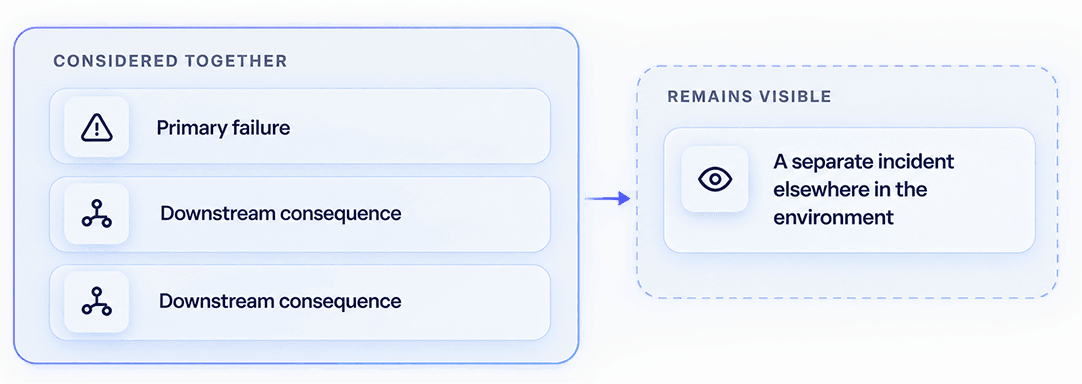
Consider a production incident in which an application begins returning errors shortly after a database connection pool becomes exhausted.

From alert correlation to incident understanding
Scrubbe approaches alert fatigue by connecting operational signals to the incidents they help explain. Rather than treating every notification as an isolated event requiring a separate investigation, Scrubbe uses its Signal Graph and autonomous investigation capabilities to examine relationships between alerts, affected services, infrastructure conditions, and relevant changes.
Its agents can investigate whether multiple symptoms share a likely underlying cause, whether an alert provides useful evidence about an existing incident, or whether a new condition requires independent attention. The objective is to reduce the manual work involved in moving from a collection of notifications to a coherent understanding of what is happening in production.
For example, when several services begin reporting errors, Scrubbe can examine their dependencies, relevant telemetry, and recent operational changes. An investigation may identify a shared database dependency experiencing failures. Another may determine whether a deployment or infrastructure change contributed to the condition.
These findings can help establish which signals are connected and which require separate investigation. Scrubbe's Ezra intelligence layer coordinates reasoning across these investigations, supporting a more systematic evaluation of the available evidence. This approach is intended to help engineering teams understand the incident represented by the alerts rather than simply process the alerts themselves.
Importantly, correlation should not be confused with confirmed causation. Where the evidence does not establish a reliable relationship between signals, the system should preserve that uncertainty instead of forcing unrelated conditions into a single explanation.
Fewer interruptions, without losing important evidence
Reducing alert fatigue does not require eliminating the detailed telemetry that engineering teams depend on. Logs, metrics, traces, and infrastructure events remain essential for understanding production behaviour.
The opportunity lies in changing how that information is interpreted and presented during incident response. An engineer investigating a service outage should not need to review every notification independently before understanding the broader failure.
Alert reduction should lead to faster investigation
Grouping related notifications is useful, but it does not necessarily resolve the operational problem. Once engineers understand that several alerts belong to the same incident, they still need to determine what caused the failure and what action is required.
A system that merely consolidates notifications may reduce visual clutter without significantly reducing investigation effort. Scrubbe is designed to connect signal analysis with autonomous investigation.
The right signal deserves the right response
An effective incident response process should make it easier to recognize significant failures without overwhelming engineers with unnecessary notifications.
That requires more than reducing alert counts. It requires understanding which signals are related, which conditions indicate genuine service degradation, and which evidence is relevant to establishing the cause.
Scrubbe brings autonomous investigation and connected operational context into this process. Its agents examine alerts alongside infrastructure telemetry, service dependencies, deployment activity, and historical incidents to help establish what is happening in production.
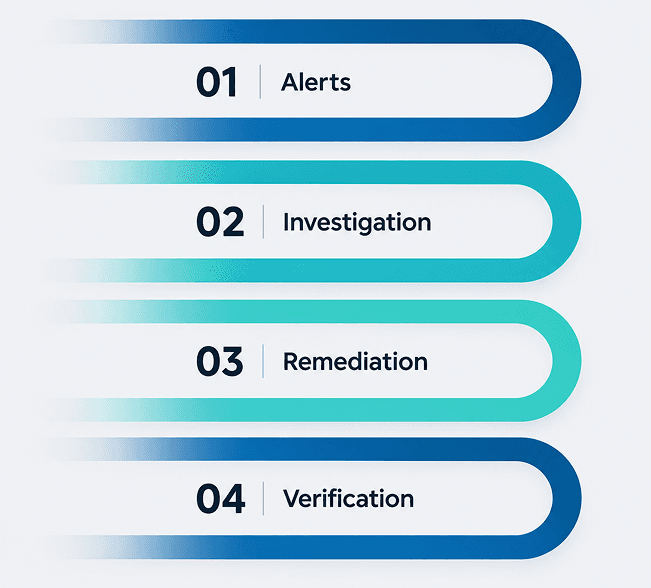
The goal is to reduce fragmented triage, preserve important evidence, and direct engineering attention toward the failures that require action. Where remediation is appropriate, Scrubbe's policy-governed execution and verification capabilities connect the investigation to controlled recovery. This changes the purpose of alert processing.
Less noise. Clearer incidents. Better decisions.
Alert fatigue is not simply the result of monitoring systems generating too much information. It is the consequence of expecting engineering teams to repeatedly interpret disconnected notifications without sufficient context about their relationships or significance.
More monitoring does not automatically produce better incident response. The value comes from turning operational signals into useful evidence, identifying the failures that require attention, and supporting decisions that lead to recovery.

Scrubbe is designed to make that process more systematic. By connecting signals, investigating potential causes, and maintaining context across the incident lifecycle,
Scrubbe helps engineering teams move from alert overload toward a clearer understanding of production failures.
Because the objective is not to receive fewer alerts at the expense of visibility. It is to spend less time managing noise and more time resolving what matters.
Move beyond manual triage
Incident response should not require engineers to repeatedly reconstruct operational context before meaningful investigation can begin. The more time spent navigating dashboards, comparing alerts, transferring information, and initiating routine investigative steps, the longer it can take to reach an informed remediation decision.
Scrubbe brings autonomous investigation, connected operational evidence, policy-governed execution, and recovery verification into a continuous incident response process.
Its agents are designed to move investigations forward independently while remaining within the authority established by the organization. Engineers remain in control of consequential decisions without having to manually direct every step.
Because the purpose of incident response is not to manage a sequence of alerts and tasks. It is to understand the failure, determine the appropriate action, and verify that the system has recovered.
Stop chasing alerts. Start understanding incidents.
Connect fragmented monitoring signals, investigate related failures, and move from alert overload to evidence-based incident response with Scrubbe.

Cookie preferences
We use essential cookies to keep Scrubbe secure and functional. You can choose whether to allow analytics, preferences, and marketing cookies, and update your choices at any time.
Essential cookies
Required for security, session continuity, consent state, and core site functionality. These are always on.
Analytics cookies
Help us understand usage patterns so we can improve product pages, onboarding paths, and documentation quality.
Preference cookies
Remember selected settings such as region, UI preferences, and previously chosen site options.
Marketing cookies
Enable campaign measurement and more relevant follow-up communications across trusted channels.
Your choices are stored locally in this browser and can be updated at any time from the cookie settings button.