Scrubbe Logo

Grow Operational Confidence as Systems Grow

As engineering organizations grow, the systems they operate become more complex. New services are introduced, infrastructure expands, dependencies multiply, and more teams become responsible for maintaining different parts of the production environment.

Illustrative model of the dynamic described on this page, not measured data. Hover or drag across the chart, or choose a stage.

Growth changes the nature of production failures

In a smaller engineering environment, production incidents may be relatively straightforward to investigate. A limited number of services, familiar infrastructure, and direct communication between engineers can make it easier to identify where a problem originated.

As the architecture expands, those advantages become harder to maintain. Applications are separated into services with independent deployment cycles. Shared infrastructure supports multiple workloads. External dependencies introduce additional points of failure, while distributed systems create more complicated relationships between causes and symptoms.

A failure in one component may appear elsewhere in the environment. An overloaded database can cause application timeouts across several services. A networking issue can disrupt dependencies that appear unrelated. A configuration change in a shared platform may affect applications owned by different engineering teams.

Service AApplication timeoutsService BMost visible symptomsService CApplication timeoutsOverloaded databaseUnderlying failure

The limits of relying on individual expertise

Experienced engineers are often the most valuable resource during a production incident. They understand the architecture, recognize recurring failure patterns, and know which systems to examine when particular symptoms appear.

In many organizations, this expertise becomes an informal foundation of reliability. A senior platform engineer may know why a particular service fails under heavy load. An application owner may remember a deployment issue that occurred several months earlier. An SRE may understand a dependency relationship that is not fully represented in existing documentation.

This knowledge helps teams resolve incidents, but it also creates dependencies on specific individuals. As organizations grow, those dependencies become harder to sustain. On-call rotations expand. Engineers move between teams. Services change ownership, and infrastructure evolves beyond the people who originally designed it.

Senior platform engineerWhy a particular service fails under heavy loadApplication ownerA deployment issue from several months earlierSREA dependency relationship not fully represented in documentation

More visibility does not guarantee greater confidence

Growing engineering organizations invest heavily in observability. They introduce monitoring platforms, distributed tracing, centralized logging, infrastructure dashboards, and incident management tools. These systems provide essential visibility into production behaviour.

However, visibility alone does not establish an understanding of what caused a failure. An organization may be able to observe elevated latency across several services without knowing which dependency introduced the problem. It may identify a recent deployment without establishing whether the change caused the incident. It may receive dozens of alerts while engineers continue searching for the relationship between them.

The amount of available data can increase faster than the organization's ability to interpret it. This creates a gap between observability and operational confidence.

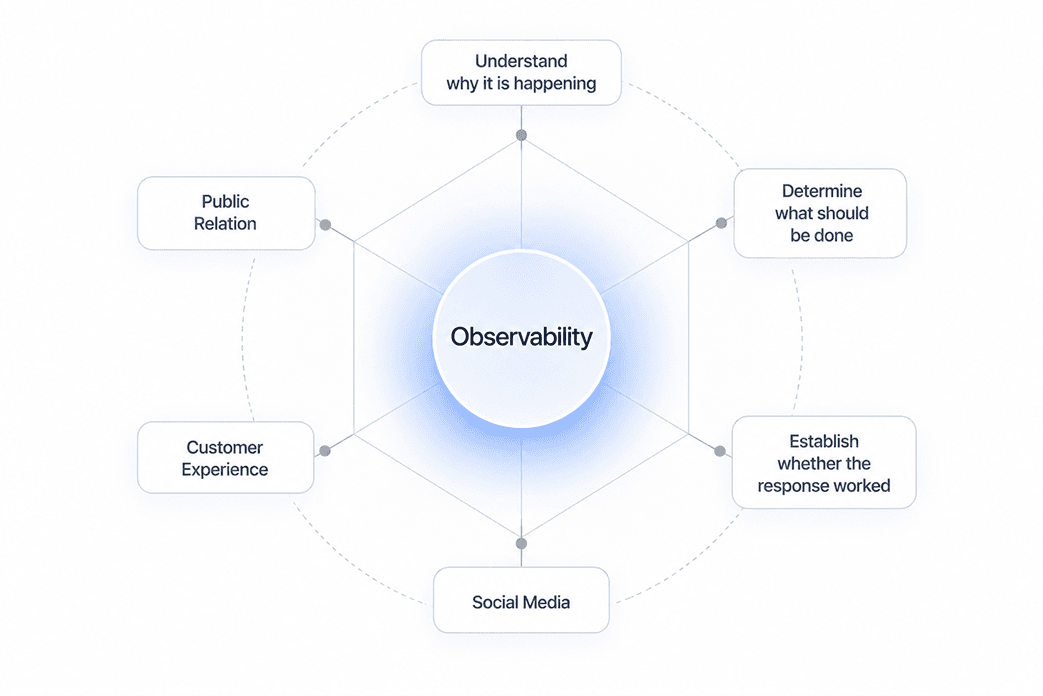
Observability at the centre of a hexagon, surrounded by what it does not answer on its own: understanding why it is happening, determining what should be done, and establishing whether the response worked.

Recovery must be measured, not assumed

As production systems become more interconnected, determining whether an incident has been resolved can be more complicated than confirming that a single service is healthy.

A database may recover while dependent applications continue experiencing errors. A deployment rollback may succeed while background processing remains delayed. An infrastructure adjustment may improve latency without restoring all affected functionality.

An action that appears successful locally may not represent complete system recovery. This makes verification an essential part of scaling reliable operations.

A database recovers
A deployment rollback succeeds
An infrastructure adjustment improves latency

Dependent applications continue experiencing errors
Background processing remains delayed
Not all affected functionality is restored

Growing systems need a stronger operational foundation

Scaling reliability is not simply a matter of adding monitoring tools, hiring more engineers, or expanding on-call coverage.

Those investments remain important, but they do not automatically address the growing complexity of incident investigation and remediation.

As systems expand, engineering organizations need a way to connect operational context, coordinate investigations, preserve knowledge, and maintain consistent authority over production changes. Scrubbe brings autonomous investigation, connected evidence, policy-governed remediation, and recovery verification into that process.

Grow your systems without losing control of them

As infrastructure becomes more distributed, the ability to understand and respond to production failures must evolve with it. Engineering organizations need more than visibility into their systems. They need reliable ways to connect evidence, identify causes, authorize corrective actions, and confirm recovery.

Scrubbe is designed to support that progression. By combining autonomous investigation with governed execution and operational learning, Scrubbe helps teams build a more consistent approach to incident response as their environments grow.

The goal is not complexity-free infrastructure. It is operational confidence that can withstand increasing complexity.

Building reliability around connected investigations

Scrubbe is designed to help engineering organizations investigate production failures across increasingly complex environments. Rather than requiring engineers to manually reconstruct every relationship between operational signals, Scrubbe uses specialized autonomous agents to examine evidence from relevant systems. Its Signal Graph helps connect operational events, service dependencies, infrastructure conditions, and other context that may contribute to an incident.

The Ezra intelligence layer coordinates investigations and supports reasoning across the available evidence. When a failure occurs, different agents can examine potential causes in parallel. One investigation may focus on recent deployments or application changes. Another may examine infrastructure health, resource constraints, or configuration changes. Others may evaluate service dependencies and relevant historical incidents.

This allows multiple explanations to be considered without requiring each investigation to be initiated and coordinated manually. As infrastructure grows, the value of this approach lies in reducing the amount of operational context engineers must reconstruct themselves. Scrubbe is intended to help teams move from fragmented observations toward a shared, evidence-based understanding of the failure.


Scale your infrastructure. Not your incident response burden.

Build a more consistent approach to production reliability with autonomous investigation, policy-governed remediation, and verified recovery.

Scrubbe can perform more of the investigation, explain the evidence behind its conclusion, and present a reasoned path forward. Engineers remain responsible for defining the boundaries, setting policy and making consequential decisions where required.

Book a demo

Cookie preferences

We use essential cookies to keep Scrubbe secure and functional. You can choose whether to allow analytics, preferences, and marketing cookies, and update your choices at any time.

Essential cookies

Required for security, session continuity, consent state, and core site functionality. These are always on.

Always active

Analytics cookies

Help us understand usage patterns so we can improve product pages, onboarding paths, and documentation quality.

Allow analytics

Preference cookies

Remember selected settings such as region, UI preferences, and previously chosen site options.

Remember preferences

Marketing cookies

Enable campaign measurement and more relevant follow-up communications across trusted channels.

Allow marketing

Your choices are stored locally in this browser and can be updated at any time from the cookie settings button.