

Scrubbe Logo

Multi agent investigation

Complex production incidents rarely have a single source. The evidence spans logs, metrics, traces, deploys, and dependencies. Scrubbe brings those investigations together into one coherent operational understanding.

Contact Us

The problem is not a lack of data.

Modern engineering environments generate enormous amounts of operational information. Logs explain behaviour. Metrics show change. Traces expose relationships. Deployments record what moved. Code repositories show what changed. Infrastructure systems reveal the state of the environment.

During an incident, however, the challenge is rarely finding another signal. It is understanding how the signals relate to one another quickly enough to form a credible explanation.

More signals do not automatically produce more understanding.

Specialization creates depth. Correlation creates understanding.

Parallel investigation alone is not enough. Five agents producing five separate answers does not create a diagnosis. The value comes from correlating their findings against the same operational context.

A finding from a deployment investigation becomes more meaningful when it aligns with a recent code change. A runtime anomaly becomes more significant when it appears immediately after that deployment. A dependency signal can either strengthen the hypothesis or provide evidence against it.

Scrubbe therefore treats individual findings as evidence rather than final answers. Findings can reinforce one another, contradict one another, or reveal relationships that would be difficult to see from any single system.

Investigation should not happen one system at a time

A single investigator moving from system to system creates a sequential process. Engineers inspect the latest deployment, then search logs, then review recent commits, then examine infrastructure, then investigate dependencies. Each step introduces another context switch while the incident continues to evolve.

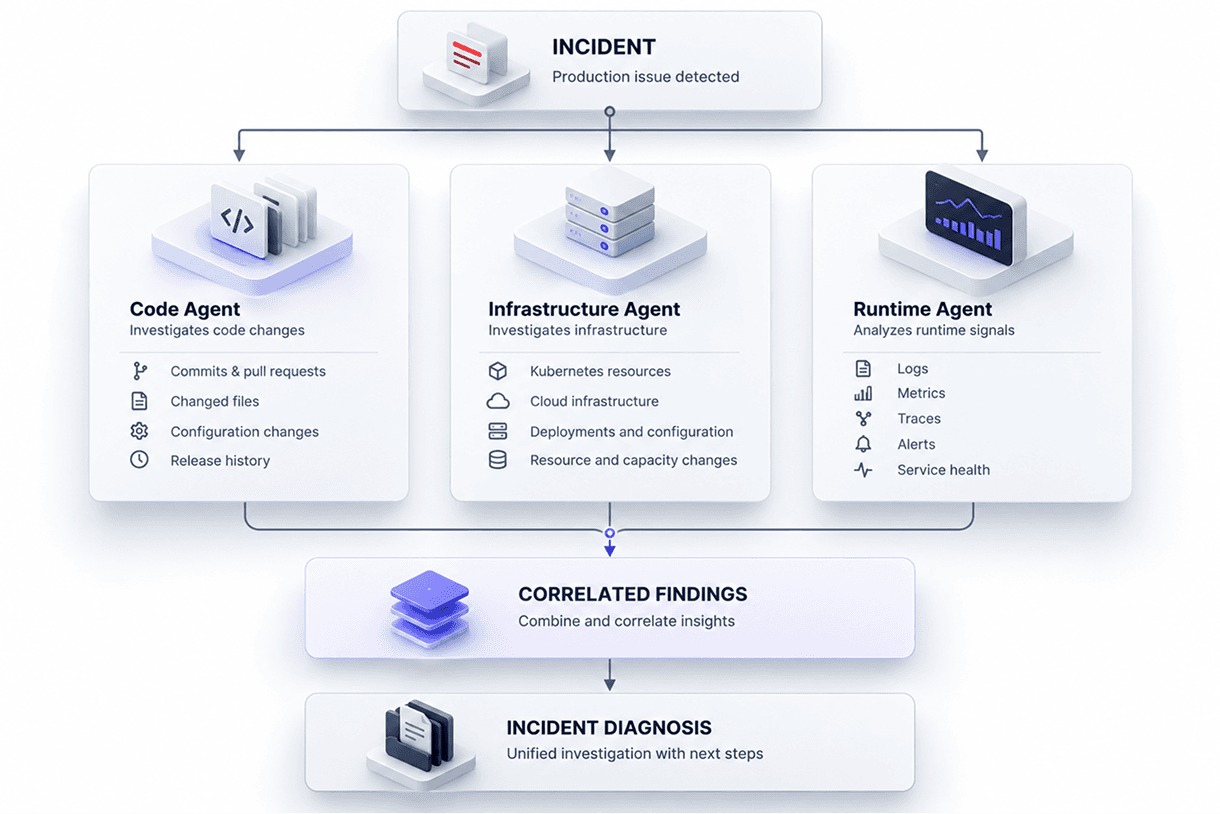
Scrubbe approaches the problem differently. Specialized agents can investigate different dimensions of the same incident at the same time. One can examine recent code changes while another investigates deployment behaviour, another examines runtime signals, and others look at dependencies or infrastructure.

The important idea is not simply that several agents are running simultaneously. It is that each investigation contributes to the understanding of one incident.

One incident fans out to a code agent, an infrastructure agent and a runtime agent running in parallel, whose findings are correlated into a single incident diagnosis.

The result is a reasoned operational conclusion

An engineer should not have to read five independent investigations and reconstruct the incident manually. The system should bring the evidence together into a concise explanation of what most likely happened, why the conclusion is credible, what could be affected and what should happen next.

Incident summary / Si-0048217

A recent deployment introduced a configuration change.

Runtime errors increased immediately after the release.

Dependency health remained within normal range.

Combined evidence supports rollback as the safest response.

Confidence: 94%·Affected services: 3

Multi agent investigation changes the role of an engineer

The purpose is not to expose more AI activity to the engineer. It is to remove the repetitive work of gathering and connecting evidence while preserving engineering judgment where it matters.

Scrubbe can perform more of the investigation, explain the evidence behind its conclusion, and present a reasoned path forward. Engineers remain responsible for defining the boundaries, setting policy and making consequential decisions where required.

Cookie preferences

We use essential cookies to keep Scrubbe secure and functional. You can choose whether to allow analytics, preferences, and marketing cookies, and update your choices at any time.

Essential cookies

Required for security, session continuity, consent state, and core site functionality. These are always on.

Always active

Analytics cookies

Help us understand usage patterns so we can improve product pages, onboarding paths, and documentation quality.

Allow analytics

Preference cookies

Remember selected settings such as region, UI preferences, and previously chosen site options.

Remember preferences

Marketing cookies

Enable campaign measurement and more relevant follow-up communications across trusted channels.

Allow marketing

Your choices are stored locally in this browser and can be updated at any time from the cookie settings button.