




Scrubbe Logo

Policy-First AI Execution

Automation has become an essential part of modern engineering operations. Deployment pipelines release applications, infrastructure tools manage cloud resources, and operational scripts perform tasks that would otherwise require repeated manual intervention.

These capabilities have made production environments easier to operate at scale. They have also increased the importance of understanding what automated systems are permitted to do, under which conditions, and with whose authority.

When automation becomes an operational risk

The risks associated with automation are not limited to software defects or failed scripts. They also arise when automated systems possess more authority than their responsibilities require.

A system with broad production permissions may be able to modify infrastructure, restart services, change configurations, or access sensitive resources without sufficient restrictions. When that system operates according to fixed instructions, its potential behaviour may be relatively predictable.

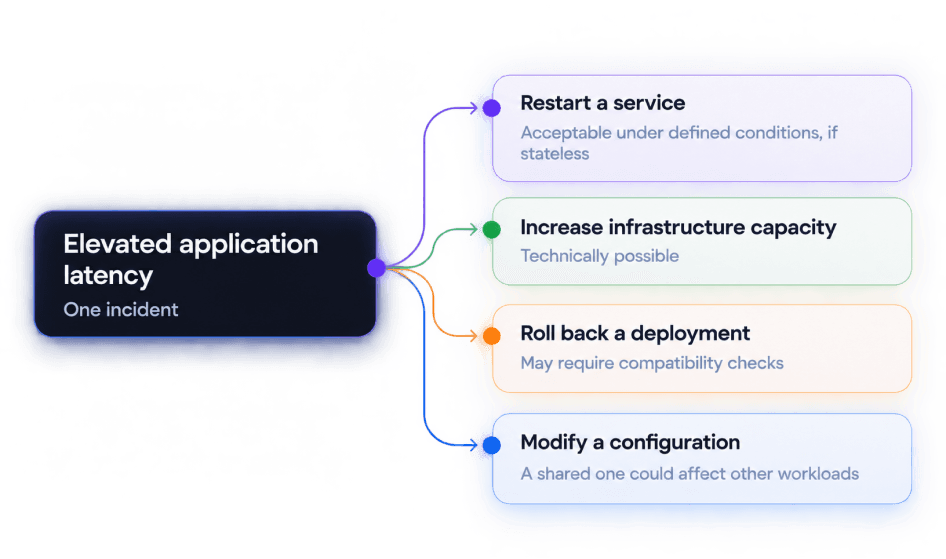
When it can independently select actions in response to changing conditions, the range of possible outcomes becomes wider. Consider an incident involving elevated application latency. An autonomous agent may identify several possible remedies: restarting a service, increasing infrastructure capacity, rolling back a deployment, or modifying a configuration.

Governance must exist before execution

Many organizations establish operational controls through access management, change approval procedures, deployment restrictions, and incident response policies. These mechanisms are intended to protect production systems from unauthorized or inappropriate changes.

However, autonomous agents introduce a need to express these controls in ways that can be enforced during automated execution. A general instruction telling an agent to act carefully is not sufficient.

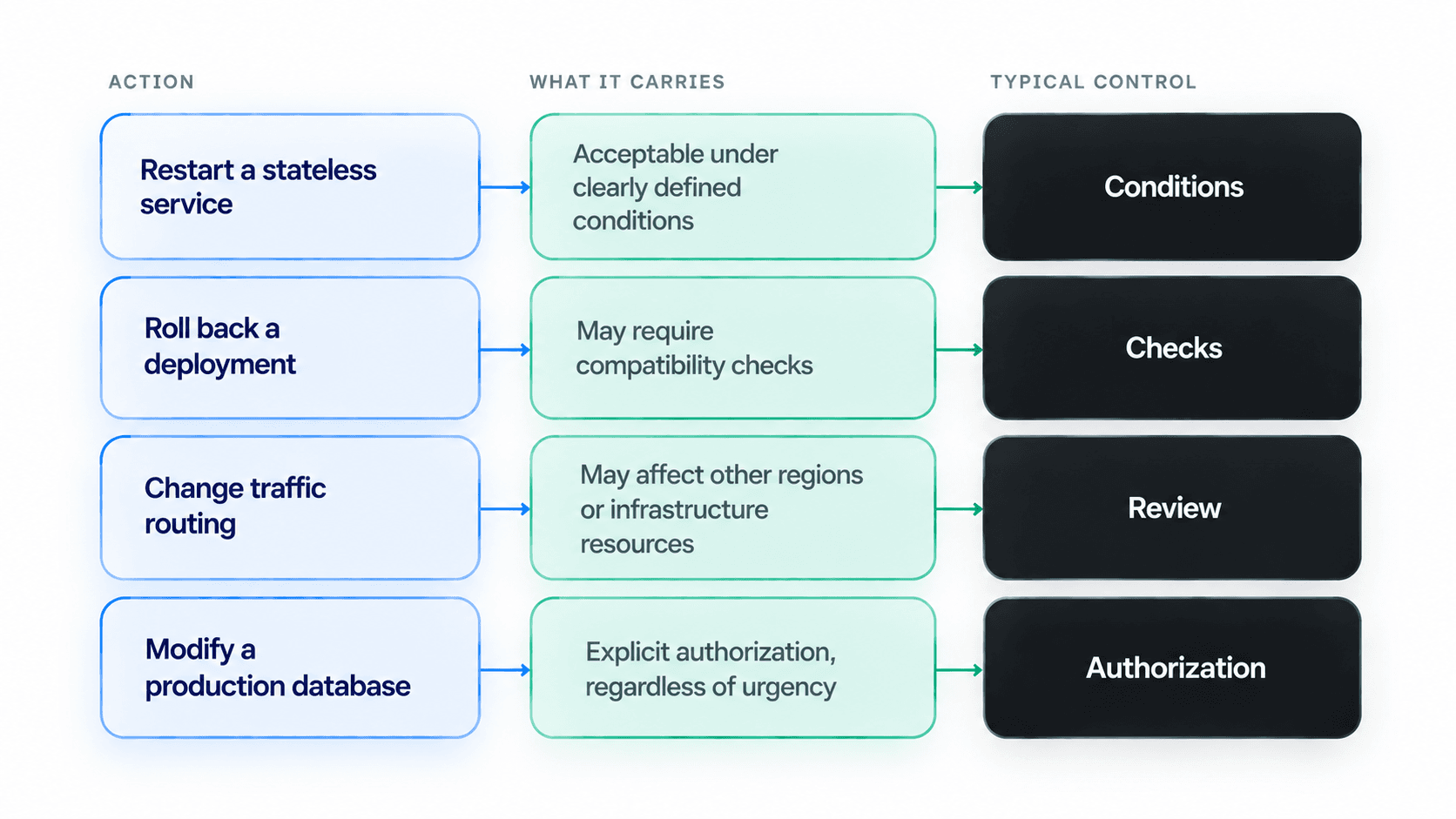
Neither is a policy document that describes acceptable behaviour without controlling the permissions available to the system. Effective governance requires explicit boundaries that determine whether a proposed action can proceed.

Separating reasoning from execution

Scrubbe is designed around a separation between autonomous investigation and authorized production action. Its specialized agents can investigate incidents, examine operational evidence, and develop remediation recommendations.

The Ezra intelligence layer coordinates agent reasoning, while the Signal Graph helps connect relevant signals, dependencies, and operational events. These capabilities allow agents to investigate independently without requiring an engineer to direct every step. Execution is treated differently.

Scrubbe's Policy Gate and Operational Rules define the boundaries within which remediation actions are permitted.

Before an agent performs an operational change, the proposed action must satisfy the applicable execution requirements. If the action is explicitly authorized and the required conditions are met, it can proceed within those boundaries. If the action requires human approval, that approval remains necessary.

Evidence must support the proposed action

Policy authorization is necessary, but it does not establish that a remediation is technically justified. An action can be permitted under an organization's rules and still be inappropriate for the incident being investigated.

For example, restarting a service may be authorized, but the underlying failure may involve an unavailable dependency that a restart cannot resolve. Rolling back a deployment may be allowed, but the deployment may have no causal relationship to the observed failure.

Human approval should be informed, not ceremonial

Some operational decisions cannot be delegated safely through predefined execution rules. A high-severity incident may involve substantial customer impact, sensitive infrastructure, incomplete evidence, or consequences that require broader organizational judgment.

In these situations, human approval remains essential. However, approval is only useful when the responsible engineer has sufficient information to evaluate the decision. A request that simply asks whether an agent may execute a command provides limited assurance. The approver needs to understand the suspected cause, the supporting evidence, and the expected operational outcome.

Execution authority must remain bounded

Production conditions can change quickly during an incident. An action that appeared appropriate at the beginning of an investigation may become unnecessary or unsafe as new evidence emerges. Another responder may already have applied a remediation. The affected service may recover independently. A dependency may change state, or a new deployment may alter the environment.

This means execution authority should not be interpreted as unlimited permission to act at any time. A proposed action must remain consistent with the conditions under which it is permitted. For reliable autonomous operations, organizations should consider controls that validate execution preconditions, limit the scope of changes, and prevent conflicting or repeated actions.

Give agents intelligence. Keep
execution governed.

Enable autonomous incident investigation and policy-controlled remediation without granting unrestricted access to production systems.

Cookie preferences

We use essential cookies to keep Scrubbe secure and functional. You can choose whether to allow analytics, preferences, and marketing cookies, and update your choices at any time.

Essential cookies

Required for security, session continuity, consent state, and core site functionality. These are always on.

Always active

Analytics cookies

Help us understand usage patterns so we can improve product pages, onboarding paths, and documentation quality.

Allow analytics

Preference cookies

Remember selected settings such as region, UI preferences, and previously chosen site options.

Remember preferences

Marketing cookies

Enable campaign measurement and more relevant follow-up communications across trusted channels.

Allow marketing

Your choices are stored locally in this browser and can be updated at any time from the cookie settings button.