
Governed Automation With Human Checkpoints
Autonomous systems are beginning to take on responsibilities that have traditionally required direct human involvement in production engineering. They can examine operational signals, investigate failures, evaluate possible causes, and identify actions that may restore service.
These capabilities introduce a significant opportunity to improve incident response. They also create a question that engineering organizations cannot afford to overlook.

Who controls what an autonomous system is allowed to do?
An agent may correctly identify the cause of a production failure and recommend a remediation. But technical accuracy does not automatically provide authority to execute that recommendation.
For autonomous operations to be reliable, organizations need more than capable agents. They need a control layer that establishes operational authority, enforces execution boundaries, and determines when human judgment is required.
Autonomy changes the nature of operational control
Autonomy changes the nature of operational control
Traditional production automation generally follows predefined instructions.
A deployment pipeline releases software according to established stages. An infrastructure automation tool applies configuration changes. A runbook executes a known recovery procedure when specific conditions are met.
These systems may be sophisticated, but their behaviour is largely determined by instructions defined in advance.
Autonomous agents operate differently.
An agent can investigate an unfamiliar incident, examine competing explanations, and determine which action may be appropriate based on the evidence available.
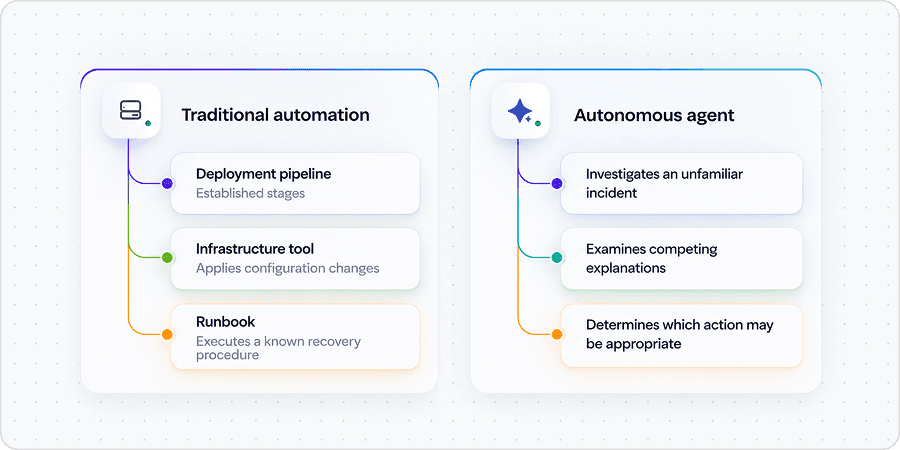
This allows it to respond to conditions that may not fit neatly into a predefined workflow.
However, the flexibility that makes autonomous investigation valuable also introduces uncertainty into execution.
An agent may identify several possible ways to resolve an incident. Some may be low-risk and reversible. Others may affect critical infrastructure or require changes beyond the authority normally granted to an on-call engineer.
Without explicit controls, the system's ability to reason can become confused with permission to act.
That distinction must remain clear.
An autonomous agent can determine what it believes should happen next. The organization must determine whether the agent is authorized to make it happen.
Why a control layer is necessary
Why a control layer is necessary
Production environments are governed by operational responsibilities that extend beyond technical problem-solving.
Engineering teams must protect customer availability, preserve data integrity, maintain security boundaries, and comply with internal change management requirements.
These responsibilities do not disappear when an action is proposed by an autonomous system.
If anything, they become more important.
An agent investigating a service outage may recommend restarting an application, rolling back a deployment, modifying infrastructure capacity, or changing traffic routing.
Each action carries different consequences.
Restarting a stateless service may be acceptable under clearly defined conditions. Rolling back a deployment may require compatibility checks. Changing traffic routing may affect other regions or infrastructure resources. Modifying a production database may require explicit authorization regardless of the urgency of the incident.
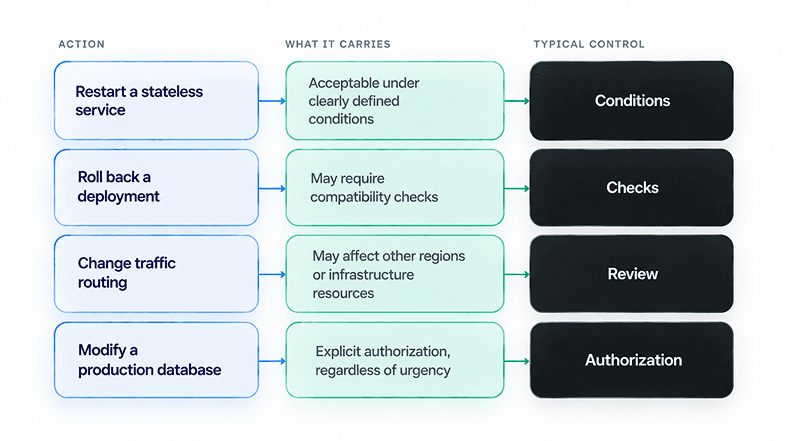
The control layer establishes the rules governing these decisions.
It determines which actions are permitted, what conditions must be satisfied, and when execution requires human approval.
Without this separation, organizations risk allowing automated systems to make consequential production changes based solely on their own assessments.
A reliable operating model must preserve organizational authority independently of the agent's reasoning process.
Reasoning and execution are different responsibilities
Reasoning and execution are different responsibilities
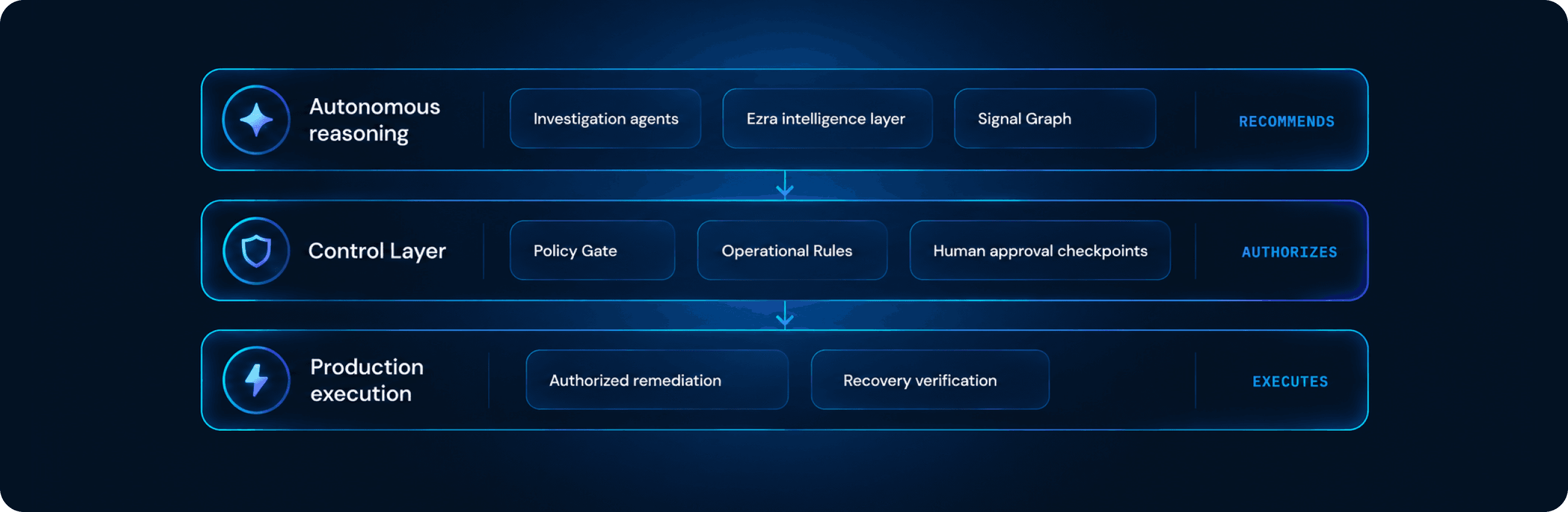
A central principle of Scrubbe's architecture is the separation between autonomous reasoning and operational execution.
Scrubbe's specialized agents can investigate production incidents independently.
They can examine logs, metrics, traces, deployment activity, service dependencies, infrastructure conditions, and historical incident context.
Its Ezra intelligence layer coordinates reasoning across investigations, while the Signal Graph helps connect relevant operational evidence.
These capabilities support a more systematic understanding of production failures.
However, an agent's conclusion does not automatically become an executable instruction.
Before a remediation action proceeds, it must be evaluated against the organization's configured operational policies.
Scrubbe's Policy Gate and Operational Rules provide the framework for defining and enforcing these boundaries.
An agent may be capable of identifying a remediation that it is not permitted to execute.
In that situation, the restriction must take precedence over the agent's recommendation.
The system can present the proposed action for approval or continue investigating within its existing authority, but it must not bypass the restriction.
This allows organizations to benefit from independent investigation without giving agents unrestricted access to production systems.
Agents determine what the evidence suggests.
Policies determine what they are allowed to execute.
Policies must be enforceable
Policies must be enforceable
Operational governance cannot depend entirely on instructions telling an autonomous agent to behave responsibly.
A general requirement to avoid dangerous actions does not define which operations are prohibited, which resources are protected, or when approval is necessary.
Nor does it provide a reliable mechanism for preventing unauthorized execution.
Effective governance requires explicit rules that can be evaluated when an action is proposed.
These rules may account for the affected environment, the type of operation, the resources involved, the current operational conditions, and the level of authorization required.
For example, an organization may permit an agent to restart a particular service in a development environment while requiring human approval for the equivalent action in production.
It may authorize diagnostic access to infrastructure while restricting configuration changes.
It may allow a narrowly scoped recovery procedure but prohibit actions affecting shared databases or sensitive permissions.
Try the control layer
An agent may restart a particular service in a development environment under the organization's rules.
Illustrative rules based on the examples above. Each organization defines its own.
The relevant boundaries must reflect the organization's own operational requirements.
Scrubbe's Policy Gate is designed to separate these authorization decisions from autonomous reasoning.
The agent can investigate and recommend. Execution proceeds only when the applicable policy permits it.
This makes governance part of the operational process rather than an advisory instruction that can be overlooked.
Human checkpoints where judgment matters
Human checkpoints where judgment matters
Not every production decision can be safely delegated through predefined rules.
Some incidents involve unfamiliar failure conditions, incomplete evidence, sensitive infrastructure, or consequences that require broader organizational judgment.
In these situations, human approval remains essential.
A control layer should make it possible to distinguish between actions that have already been authorized through policy and actions that require a new decision from a responsible engineer.
Scrubbe is designed to support this distinction.
Agents can investigate incidents, evaluate possible causes, and prepare remediation recommendations.
Where an action requires approval, the relevant investigation context can support the human decision.
The engineer should be able to understand the suspected cause, the evidence supporting the recommendation, the intended action, and the potential operational consequences.
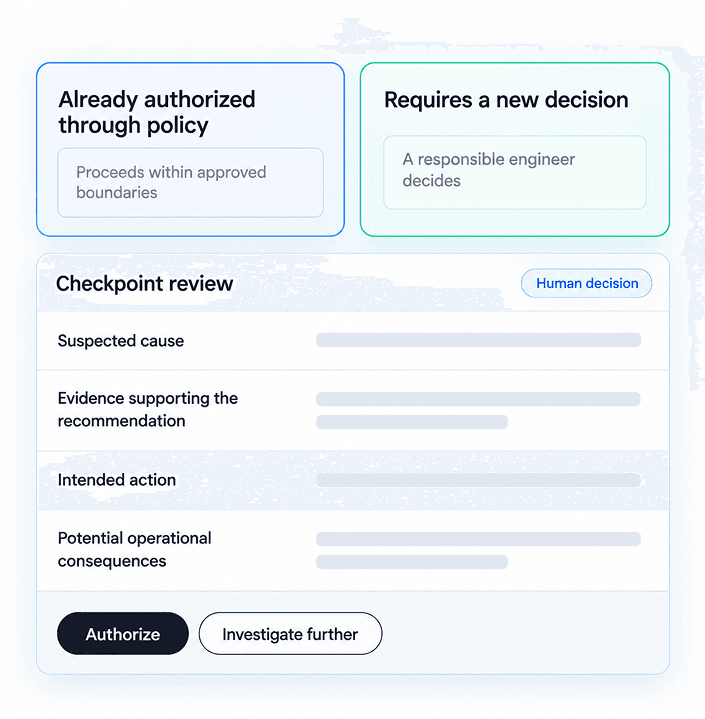
This allows human oversight to remain meaningful.
An approval checkpoint should not be reduced to confirming that an agent may run a command.
It should provide an opportunity to evaluate whether the proposed action is justified and appropriate for the current production conditions.
Where the evidence is insufficient, the engineer may decide that additional investigation is necessary.
Where the action is appropriate, authorization can be granted within the organization's established procedures.
The purpose is to preserve human accountability without requiring engineers to manually direct every stage of the investigation.
Least privilege as an operational principle
Least privilege as an operational principle
A control layer must also govern the scope of access available to autonomous systems.
An agent investigating an incident should not automatically receive permission to modify every resource it can observe.
Access to operational evidence and authority to change production systems are different responsibilities.
An investigation agent may require permission to examine application logs, infrastructure metrics, deployment records, and service dependencies.
It may not require permission to restart services, alter configurations, or modify production data.
Similarly, an agent authorized to perform a particular recovery action should not automatically gain permission to execute unrelated changes.
The principle of least privilege limits the potential consequences of incorrect decisions and reduces the risk associated with excessive access.
It also supports progressive adoption.
Organizations can begin by allowing agents to investigate and recommend actions without granting execution permissions.
As they establish confidence in specific remediation procedures, they can authorize narrowly defined actions under appropriate conditions.
Permissions should remain tied to operational responsibilities rather than expanding simply because an agent becomes more capable.
Scrubbe's policy-governed execution model is intended to support these boundaries.
Autonomous capability can increase without requiring unrestricted production authority.
Decisions need context, not just permission
Decisions need context, not just permission
An action may be permitted by policy and still be inappropriate for the incident being investigated.
A service restart may fall within an agent's execution authority, but the failure may originate from an unavailable dependency that the restart cannot resolve.
A deployment rollback may be authorized, but the deployment may not have caused the observed errors.
Governance therefore needs to operate alongside evidence-based investigation.
Scrubbe's agents are designed to examine operational signals, evaluate possible causes, and develop remediation recommendations supported by relevant evidence.
The control layer then determines whether the proposed action is authorized.
These are complementary responsibilities.
The investigation establishes why an action may be appropriate.
The policy determines whether the action is permitted.
Where human approval is required, the engineer evaluates the proposal using the available context.
Where evidence is incomplete or contradictory, further investigation may be necessary before any action should proceed.
A reliable control layer does not replace technical reasoning.
It ensures that technical reasoning cannot independently override organizational authority.
Maintaining control during execution
Maintaining control during execution
Authorization should not be treated as unlimited permission to act regardless of changing circumstances.
Production environments are dynamic.
A service may recover while an investigation is underway. Another responder may apply a remediation. A deployment may change the affected environment, or new evidence may undermine the original diagnosis.
An action that was appropriate when first proposed may no longer be justified.
For this reason, safe execution should remain connected to the conditions under which authorization was granted.
Depending on the operation, this may involve validating preconditions, restricting the scope of changes, or preventing conflicting actions.
The precise safeguards depend on the infrastructure and the remediation involved.
Scrubbe's governed execution approach establishes the principle that agents must operate within approved boundaries throughout the response.
An unsuccessful action does not authorize the agent to expand its permissions.
A new hypothesis does not remove an existing approval requirement.
And operational urgency does not justify bypassing a policy restriction.
The control layer must remain authoritative even when the agent is attempting to restore service.
Verification closes the operational loop
Verification closes the operational loop
A completed action is not the same as a resolved incident.
A service restart may succeed while application errors continue. A rollback may complete without restoring downstream functionality. A configuration change may improve one component while introducing problems elsewhere.
This is why governed automation must connect execution to verification.
Scrubbe's verification capabilities are intended to assess whether an authorized remediation produced the expected operational outcome.
After execution, relevant system signals can be examined to determine whether the affected service has recovered and whether the original symptoms have subsided.
Where recovery is incomplete, the investigation may need to continue.
Any additional remediation remains subject to the organization's execution policies and approval requirements.
Verification provides an important accountability mechanism.
It distinguishes between an agent successfully performing an action and that action actually improving the production environment.
This information can also inform future investigations and help engineering teams evaluate the effectiveness of established remediation procedures.
The goal is a connected response process in which decisions, execution, and outcomes remain visible.
Accountability must extend across the incident
Accountability must extend across the incident
As autonomous systems take on greater operational responsibilities, organizations need a clear understanding of how decisions were made and what actions occurred.
This requires more than a record of executed commands.
A useful operational history should connect the incident, supporting evidence, proposed remediation, applicable policy, authorization decision, execution activity, and observed outcome.
Where human approval was required, the decision should be attributable to the responsible authority.
Where an action was performed autonomously, the organization should be able to establish the policy under which it proceeded.
These records support incident reviews, security oversight, operational accountability, and continuous improvement.
They also help organizations identify where their controls may need refinement.
A policy that repeatedly blocks a safe recovery procedure may deserve review. A remediation that consistently fails verification may require changes to the underlying operational approach.
Scrubbe's architecture is intended to keep investigation, governance, execution, and verification connected rather than treating them as unrelated stages.
This creates a clearer basis for understanding autonomous behaviour and evaluating its consequences.
A foundation for scaling autonomous operations
A foundation for scaling autonomous operations
The difference lies in the authority they choose to delegate.
A control layer allows organizations to establish that authority according to their own operational requirements.
They can begin with investigation and recommendations, authorize selected low-risk procedures, and expand autonomy as confidence and evidence justify it.
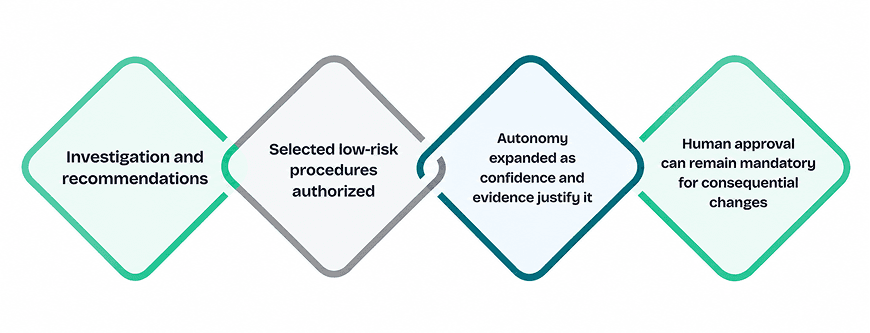
Human approval can remain mandatory for consequential changes.
This progression allows autonomous capabilities to grow without requiring organizations to abandon established security and reliability practices.
Scrubbe is designed to support this model through independent agent reasoning and policy-defined execution.
The organization remains responsible for determining where automation is appropriate and where human authority must be retained.
The control layer is what makes autonomy operationally credible
The control layer is what makes autonomy operationally credible
Autonomous incident response is not simply about developing agents that can diagnose failures and recommend fixes.
It is about creating an operating model in which those capabilities can be used responsibly in production.
Engineering teams need confidence that agents will respect access restrictions, follow operational policies, preserve uncertainty, and seek approval when necessary.
Security teams need assurance that execution authority remains limited and enforceable.
Engineering leadership needs visibility into the decisions being made, the actions being performed, and the outcomes that follow.
These requirements are not separate from autonomous capability.
They determine whether that capability can be trusted with real operational responsibilities.
Scrubbe's Control Layer is built around this distinction.
Agents can investigate independently, but execution remains governed by the organization's policies.
Human checkpoints preserve authority over consequential decisions, while verification provides evidence about the results of authorized remediation.
This makes it possible to introduce greater autonomy without treating control as an afterthought.
Autonomy should operate within your authority
Autonomy should operate within your authority
The future of incident response will involve systems capable of investigating failures and taking increasingly sophisticated operational actions.
But greater capability must be matched by clearer governance.
Organizations need to define what autonomous agents can do, when they can do it, and which decisions must remain with human responders.
Scrubbe brings autonomous investigation, policy-gated execution, human approval checkpoints, and recovery verification into a connected operational model.
Its agents can reason independently and contribute to incident resolution, but they operate within the boundaries established by the organization.
The objective is not to remove engineers from operational control.
It is to reduce repetitive manual work while ensuring that consequential production decisions remain authorized, understandable, and accountable.
Because trustworthy autonomy is not defined by how much control an agent has.
It is defined by how reliably that control is governed.

Let agents investigate. Keep production under your control.
Define execution boundaries, establish human approval checkpoints, and govern autonomous remediation with Scrubbe
Cookie preferences
We use essential cookies to keep Scrubbe secure and functional. You can choose whether to allow analytics, preferences, and marketing cookies, and update your choices at any time.
Essential cookies
Required for security, session continuity, consent state, and core site functionality. These are always on.
Analytics cookies
Help us understand usage patterns so we can improve product pages, onboarding paths, and documentation quality.
Preference cookies
Remember selected settings such as region, UI preferences, and previously chosen site options.
Marketing cookies
Enable campaign measurement and more relevant follow-up communications across trusted channels.
Your choices are stored locally in this browser and can be updated at any time from the cookie settings button.